





/NASA’s%20Artemis%20III%20Announcement%20(Official%20NASA%20Trailer)~thumb.jpg)

The United Launch Alliance Atlas V rocket, carrying the Solar Orbiter, climbs upward after liftoff from Space Launch Complex 41 on Cape Canaveral Air Force Station in Florida on Feb. 9, 2020. Liftoff was at 11:03 p.m. EST. Solar Orbiter is an international co…
Ver en NASA ↗🚀 Biblioteca espacial oficial
Imágenes y vídeos de NASA
Explora el catálogo multimedia público de NASA sin salir de TuPortalNews.
Explora temas destacados
Selecciona un tema o realiza una búsqueda personalizada.
6.539 resultados en NASA
The United Launch Alliance Atlas V rocket, carrying the Solar Orbiter, climbs upward after liftoff from Space Launch Complex 41 on Cape Canaveral Air Force Station in Florida on Feb. 9, 2020. Liftoff was at 11:03 p.m. EST. Solar Orbiter is an international co…
Ver en NASA ↗The United Launch Alliance Atlas V rocket, carrying the Solar Orbiter, lifts off Space Launch Complex 41 at Cape Canaveral Air Force Station in Florida at 11:03 p.m. EST, on Feb. 9, 2020. Solar Orbiter is an international cooperative mission between ESA (Euro…
Ver en NASA ↗The United Launch Alliance Atlas V rocket, carrying the Solar Orbiter, lifts off Space Launch Complex 41 at Cape Canaveral Air Force Station in Florida at 11:03 p.m. EST, on Feb. 9, 2020. Solar Orbiter is an international cooperative mission between ESA (Euro…
Ver en NASA ↗The ridges in this image from NASA's 2001 Mars Odyssey spacecraft are creating shadows due to low sun angle.
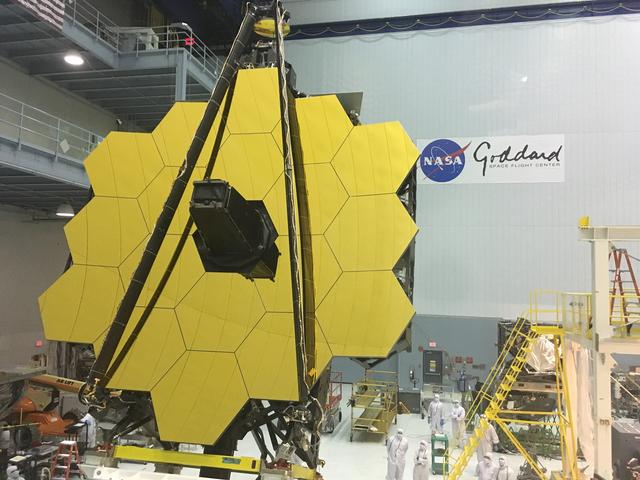
Ver en NASA ↗This animation shows the preliminary design for the spacecraft, including hexagonal sun shields that will help keep the instruments cool.
Ver en NASA ↗This composite image made from six frames shows the International Space Station, with a crew of seven aboard, in silhouette as it transits the sun at roughly five miles per second, Friday, April 23, 2021, as seen from Nottingham, Maryland. Aboard are: NASA as…
Ver en NASA ↗The International Space Station, with a crew of six onboard, is seen in silhouette as it transits the Sun at roughly five miles per second during a partial solar eclipse, Monday, Aug. 21, 2017 near Banner, Wyoming. Onboard as part of Expedition 52 are: NASA …
Ver en NASA ↗The International Space Station, with a crew of six onboard, is seen in silhouette as it transits the Sun at roughly five miles per second during a partial solar eclipse, Monday, Aug. 21, 2017 near Banner, Wyoming. Onboard as part of Expedition 52 are: NASA …
Ver en NASA ↗This composite image, made from seven frames, shows the International Space Station, with a crew of six onboard, as it transits the Sun at roughly five miles per second during a partial solar eclipse, Monday, Aug. 21, 2017 near Banner, Wyoming. Onboard as par…
Ver en NASA ↗Watch a video from this event here: www.flickr.com/photos/gsfc/14118958800/ A coronal mass ejection, or CME, surged off the side of the sun on May 9, 2014, and NASA's newest solar observatory caught it in extraordinary detail. This was the first CME observed…
Ver en NASA ↗Watch a video from this event here: www.flickr.com/photos/gsfc/14118958800/ A coronal mass ejection, or CME, surged off the side of the sun on May 9, 2014, and NASA's newest solar observatory caught it in extraordinary detail. This was the first CME observed…
Ver en NASA ↗On March 29, 2014 the sun released an X-class flare. It was observed by NASA's Interface Region Imaging Spectrograph, or IRIS; NASA's Solar Dynamics Observatory, or SDO; NASA's Reuven Ramaty High Energy Solar Spectroscopic Imager, or RHESSI; the Japanese Aero…
Ver en NASA ↗A combination of many (but not all) of the datasets which observed this flare. -- On March 29, 2014 the sun released an X-class flare. It was observed by NASA's Interface Region Imaging Spectrograph, or IRIS; NASA's Solar Dynamics Observatory, or SDO; NASA…
Ver en NASA ↗On March 29, 2014 the sun released an X-class flare. It was observed by NASA's Interface Region Imaging Spectrograph, or IRIS; NASA's Solar Dynamics Observatory, or SDO; NASA's Reuven Ramaty High Energy Solar Spectroscopic Imager, or RHESSI; the Japanese Aero…
Ver en NASA ↗Watch a video from this event here: www.flickr.com/photos/gsfc/14118958800/ A coronal mass ejection, or CME, surged off the side of the sun on May 9, 2014, and NASA's newest solar observatory caught it in extraordinary detail. This was the first CME observed…
Ver en NASA ↗Watch a video from this event here: www.flickr.com/photos/gsfc/14118958800/ A coronal mass ejection, or CME, surged off the side of the sun on May 9, 2014, and NASA's newest solar observatory caught it in extraordinary detail. This was the first CME observed…
Ver en NASA ↗On Aug. 24, 2014, the sun emitted a mid-level solar flare, peaking at 8:16 a.m. EDT. NASA's Solar Dynamics Observatory captured images of the flare, which erupted on the left side of the sun. Solar flares are powerful bursts of radiation. Harmful radiation fr…
Ver en NASA ↗The sun emitted a significant solar flare, peaking at 1:01 a.m. EDT on Oct. 19, 2014. NASA's Solar Dynamics Observatory, which is always observing the sun, captured an image of the event. Solar flares are powerful bursts of radiation. Harmful radiation from a…
Ver en NASA ↗Zoom in on the flare in ultraviolet (SDO/AIA), X-rays (Hinode) and gamma-rays (RHESSI) -- On March 29, 2014 the sun released an X-class flare. It was observed by NASA's Interface Region Imaging Spectrograph, or IRIS; NASA's Solar Dynamics Observatory, or S…
Ver en NASA ↗Extreme ultraviolet light streams out of an X-class solar flare as seen in this image captured on March 29, 2014, by NASA's Solar Dynamics Observatory. This image blends two wavelengths of light: 304 and 171 Angstroms, which help scientists observe the lower …
Ver en NASA ↗Extreme ultraviolet light streams out of an X-class solar flare as seen in this image captured on March 29, 2014, by NASA's Solar Dynamics Observatory. This image blends two wavelengths of light: 304 and 171 Angstroms, which help scientists observe the lower …
Ver en NASA ↗An active region just about squarely facing Earth erupted with an X 1.6 flare (largest class) as well as a coronal mass ejection (CME) on Sept. 10-11, 2014. This event featured both a long flare decay time and a storm of electrically charged, energetic partic…
Ver en NASA ↗CAPE CANAVERAL, Fla. – Workers prepare to lift a nose cone to top out one of a pair of replica space shuttle solid rocket boosters at the entry of the space shuttle Atlantis attraction under construction at the Kennedy Space Center Visitor Complex. Workers wi…
Ver en NASA ↗Contenido y metadatos proporcionados por la NASA Image and Video Library.