




/NASA’s%20Artemis%20III%20Announcement%20(Official%20NASA%20Trailer)~thumb.jpg)

This artist concept based on data from NASA Cassini spacecraft, shows a glowing patch of ultraviolet light near Saturn north pole that occurs at the footprint of the magnetic connection between Saturn and its moon Enceladus.
Ver en NASA ↗🚀 Biblioteca espacial oficial
Imágenes y vídeos de NASA
Explora el catálogo multimedia público de NASA sin salir de TuPortalNews.
Explora temas destacados
Selecciona un tema o realiza una búsqueda personalizada.
4.237 resultados en NASA
MITZI ADAMS, MARSHALL SCIENTIST, TALKED WITH STUDENTS AT THE U.S. SPACE AND ROCKET CENTER ON FRIDAY, JULY 19 ABOUT THE PLANET SATURN. STUDENTS PARTICIPATED ALONG WITH LEGIONS OF SMILING EARTHLINGS IN A WAVE AT SATURN FOR A COSMIC PHOTO OP AS NASA’S CASSINI TO…
Ver en NASA ↗MITZI ADAMS, MARSHALL SCIENTIST, TALKED WITH STUDENTS AT THE U.S. SPACE AND ROCKET CENTER ON FRIDAY, JULY 19 ABOUT THE PLANET SATURN. STUDENTS PARTICIPATED ALONG WITH LEGIONS OF SMILING EARTHLINGS IN A WAVE AT SATURN FOR A COSMIC PHOTO OP AS NASA’S CASSINI TO…
Ver en NASA ↗These images taken by NASA's Cassini spacecraft show clumps seemingly embedded within Saturn narrow, outermost F ring.
Ver en NASA ↗Astronomers are studying the unusual appearance of Saturn's rings. The top portion of this Hubble Space Telescope snapshot shows Saturn with its rings barely visible. Normally, astronomers see Saturn with its rings tilted, but because the Earth was almost in …
Ver en NASA ↗With giant Saturn hanging in the blackness and sheltering Cassini from the sun blinding glare, the spacecraft viewed the rings as never before, revealing previously unknown faint rings and even glimpsing its home world.
Ver en NASA ↗Off the shoulder of giant Saturn, a bright pinpoint marks the location of the ring moon Atlas image center. Shadows cast by the C ring adorn the planet at upper right
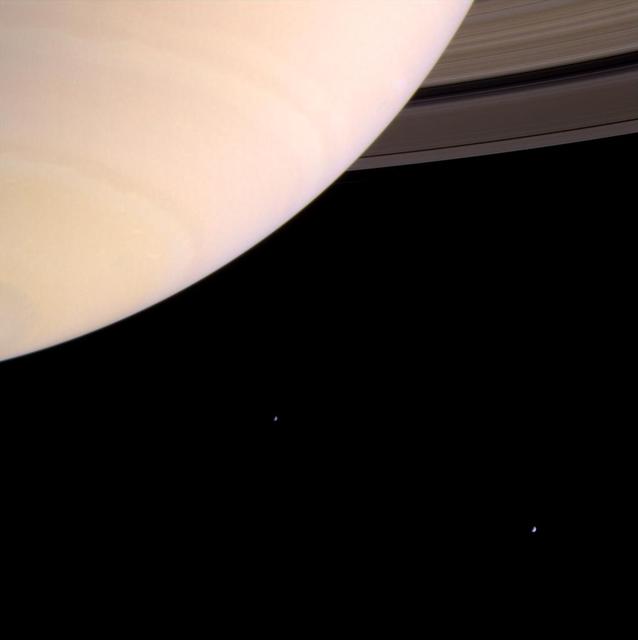
Ver en NASA ↗The immense size of Saturn is emphasized in this portrait by NASA Cassini spacecraft that features the moon Mimas shown in front of the planet. Mimas appears as only a small dot above the rings near the center of the image.
Ver en NASA ↗Large regions of Saturn night side are illuminated by the planet gleaming rings. Except for a sliver of the sunlit crescent at left, this view shows a part of the planet lit almost entirely by ringshine.
Ver en NASA ↗This illustration imagines the view from NASA's Cassini spacecraft during one of its final dives between Saturn and its innermost rings, as part of the mission's Grand Finale.
Ver en NASA ↗This image of Saturn's outer A ring features the small moon Daphnis and the waves it raises in the edges of the Keeler Gap. The image was taken by NASA's Cassini spacecraft on Sept. 13, 2017. It is among the last images Cassini sent back to Earth.
Ver en NASA ↗The Cassini spacecraft looks toward the Saturnian horizon as Dione and Janus glide past
Ver en NASA ↗The giant planet is a moody world whose disposition appears to change with he view. Its atmosphere rages with thunderous and hurricane-like storms. Its majestic rings spin a tale of ancient collisions and cataclysm
Ver en NASA ↗Captured by NASA's Cassini spacecraft, Saturn rings appear to bend as they pass behind the planet darkened limb due to refraction by Saturn upper atmosphere.
Ver en NASA ↗Developed by the Marshall Space Flight Center (MSFC) as an interim vehicle in MSFC’s “building block” approach to the Saturn rocket development, the Saturn IB utilized Saturn I technology to further develop and refine the larger boosters and the Apollo spacec…
Ver en NASA ↗The Saturn V first stages were test fired at the Mississippi Test Facility and at the Marshall Space Flight Center (MSFC). Five F-1 engines powered the first stage, each developing 1.5 million pounds of thrust. The first stage, known as the S-IC stage, burned…
Ver en NASA ↗Fairchild technicians check out the extended Pegasus meteoroid detection surface. The Pegasus was developed by Fairchild Stratos Corporation, Hagerstown, Maryland, for NASA through the Marshall Space Flight Center. Three Pegasus satellites were flown aboard S…
Ver en NASA ↗An Apollo spacecraft mockup marks the capstone of the new tribute to the crew of Apollo 1 who perished in a fire at the launch pad on Jan. 27, 1967, during training for the mission. The tribute highlights the lives and careers of astronauts Gus Grissom, Ed Wh…
Ver en NASA ↗The crew access arm that astronauts walked across to reach the Apollo spacecraft for missions to the moon serves as the exit for the new tribute to the crew of Apollo 1 who perished in a fire at the launch pad on Jan. 27, 1967, during training for the mission…
Ver en NASA ↗A display case dedicated to astronaut Gus Grissom is shown inside the new tribute to the crew of Apollo 1 who perished in a fire at the launch pad on Jan. 27, 1967, during training for the mission. Grissom, Ed White II and Roger Chaffee were lost during the f…
Ver en NASA ↗The new tribute to the crew of Apollo 1 who perished in a fire at the launch pad on Jan. 27, 1967, during training for the mission is shown looking down the length of the area. The tribute highlights the lives and careers of astronauts Gus Grissom, Ed White I…
Ver en NASA ↗A redesigned hatch for an Apollo spacecraft is shown inside the new tribute to the crew of Apollo 1 who perished in a fire at the launch pad on Jan. 27, 1967, during training for the mission. Astronauts Gus Grissom, Ed White II and Roger Chaffee were lost dur…
Ver en NASA ↗A gateway featuring the Apollo 1 mission logo over the moon is shown inside the new tribute to the crew of Apollo 1 who perished in a fire at the launch pad on Jan. 27, 1967, during training for the mission. Astronauts Gus Grissom, Ed White II and Roger Chaff…
Ver en NASA ↗A display case dedicated to astronaut Ed White II is shown inside the new tribute to the crew of Apollo 1 who perished in a fire at the launch pad on Jan. 27, 1967, during training for the mission. Gus Grissom, White and Roger Chaffee were lost during the fir…
Ver en NASA ↗Contenido y metadatos proporcionados por la NASA Image and Video Library.