





/NASA’s%20Artemis%20III%20Announcement%20(Official%20NASA%20Trailer)~thumb.jpg)

Gerry Griffin, Apollo flight director, makes remarks during the Apollo 11 50th Gala, pressented by Northrop Grumman, inside the Apollo/Saturn V Center at the Kennedy Space Center Visitor Complex on July 16, 2019
Ver en NASA ↗🚀 Biblioteca espacial oficial
Imágenes y vídeos de NASA
Explora el catálogo multimedia público de NASA sin salir de TuPortalNews.
Explora temas destacados
Selecciona un tema o realiza una búsqueda personalizada.
4.237 resultados en NASA
A vortex that was part of a giant storm on Saturn slowly dissipates over time in this set of false color images from NASA Cassini spacecraft.
Ver en NASA ↗Bright equatorial clouds give way to darker southern bands in this infrared Cassini spacecraft view taken with a filter sensitive to methane absorption in Saturn atmosphere
Ver en NASA ↗Dark and sharply defined ring shadows appear to constrict the flow of color from Saturn warmly hued south to the bluish northern latitudes
Ver en NASA ↗This frame from an infrared movie from NASA Cassini mission shows the churning of the curious six-sided jet stream at Saturn north pole known as the hexagon.
Ver en NASA ↗Shadows cast by Saturn rings darken the southern hemisphere of the planet and give a truncated appearance to the bottom of this image captured by NASA Cassini spacecraft.
Ver en NASA ↗The plumes of Enceladus continue to gush icy particles into Saturn orbit, making this little moon one of a select group of geologically active bodies in the solar system
Ver en NASA ↗With no solid land to obstruct their progress, dark vortices often roll through Saturn atmosphere for months or years, before merging with other vortices
Ver en NASA ↗The north pole of Saturn, in the fresh light of spring, is revealed in this color image from NASA Cassini spacecraft. The north pole was previously hidden from the gaze of Cassini.
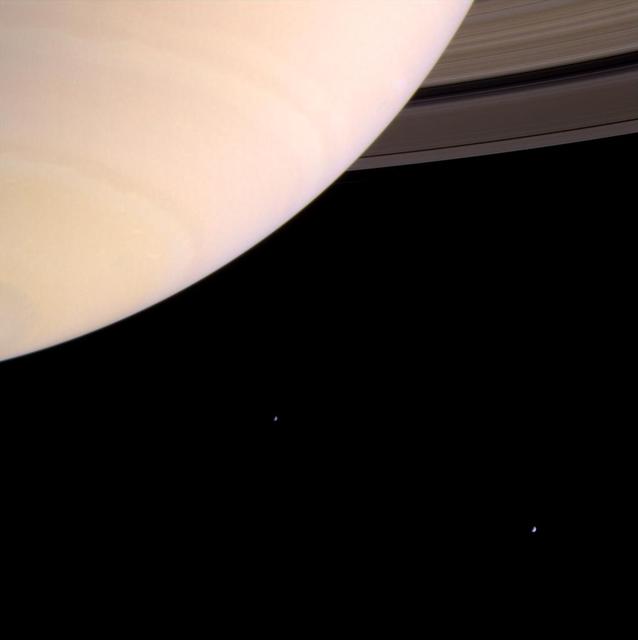
Ver en NASA ↗The small, dark form of Janus cruises along in front of bright Saturn. The edge-on rings cast dramatic shadows onto the northern hemisphere
Ver en NASA ↗The Cassini spacecraft gazes upward at the face of giant Saturn, seeing beyond the equator to where ring shadows fall across the bluish northern latitudes
Ver en NASA ↗Gaseous Saturn rotates quickly -- once every approximately 10.8 hours -- and its horizontal cloud bands rotate at different rates relative to each other
Ver en NASA ↗These false-color mosaics from NASA Cassini spacecraft chronicle the changing appearance of the huge storm that developed from a small spot in Saturn northern hemisphere.
Ver en NASA ↗A huge storm churning through the atmosphere in Saturn northern hemisphere overtakes itself as it encircles the planet in this true-color view from NASA Cassini spacecraft.
Ver en NASA ↗This close-up view of Saturn atmosphere shows a circular vortex surrounded by numerous attendant bright clouds. Some blurring due to spacecraft motion is apparent in this view
Ver en NASA ↗The tilted crescent of Saturn displays lacy cloud bands here along with a bright equatorial region and threadlike ring shadows on the northern hemisphere
Ver en NASA ↗Cassini casts powerful eyes on our home planet, and captures Earth, a pale blue orb -- and a faint suggestion of our moon -- among the glories of the Saturn system.
Ver en NASA ↗In this image captured by NASA Cassini spacecraft, Saturn fascinating meteorology manifests itself in a tring of pearls formation, spanning over 60,000 kilometers 37,000 miles.
Ver en NASA ↗NASA Cassini orbiter peered out over the northern territory on Saturn moon Enceladus, during its final close flyby of Enceladus, on Dec. 19, 2015.
Ver en NASA ↗A large storm roils Saturn atmosphere on the left of this NASA Cassini spacecraft image. This view looks toward a region centered at 24 degrees south of the planet equator.
Ver en NASA ↗NASA Cassini orbiter shows its final close flyby of Enceladus to focus on the icy moon craggy, dimly lit limb, with the planet Saturn beyond.
Ver en NASA ↗The head of Saturn huge northern storm is well established in this view captured early in the storm development by NASA Cassini spacecraft in late 2010.
Ver en NASA ↗This frame from an animation from NASA Cassini spacecraft shows the swirling clouds in a vortex spawned by a great northern storm on Saturn. The clouds are moving in a clockwise direction.
Ver en NASA ↗The smooth, linear contours and long, gently meandering character of the clouds in this view suggest stable prevailing winds at these latitudes, from 57 to 67 degrees north on Saturn
Ver en NASA ↗Contenido y metadatos proporcionados por la NASA Image and Video Library.