





/NASA’s%20Artemis%20III%20Announcement%20(Official%20NASA%20Trailer)~thumb.jpg)

NASA has awarded a total of $1.5 million to two U.S. teams for their novel technology solutions addressing energy distribution, management, and storage as part of the agency’s Watts on the Moon Challenge. The innovations from this challenge aim to support NAS…
Ver en NASA ↗🚀 Biblioteca espacial oficial
Imágenes y vídeos de NASA
Explora el catálogo multimedia público de NASA sin salir de TuPortalNews.
Explora temas destacados
Selecciona un tema o realiza una búsqueda personalizada.
19.945 resultados en NASA
Philip Lubin from H.E.L.P.S. (High Efficiency Long-Range Power Solution) from The University of California gives their presentation. NASA has awarded a total of $1.5 million to two U.S. teams for their novel technology solutions addressing energy distributi…
Ver en NASA ↗Philip Lubin from Team H.E.L.P.S. (High Efficiency Long-Range Power Solution) explains his project to Mary Wadel and Stephen Bowen. NASA has awarded a total of $1.5 million to two U.S. teams for their novel technology solutions addressing energy distribution…
Ver en NASA ↗This narrow angle image taken NASA Cassini camera system of the Moon is one of the best of a sequence of narrow angle frames taken as the spacecraft passed by the Moon on the way to its closest approach with Earth on August 17, 1999.
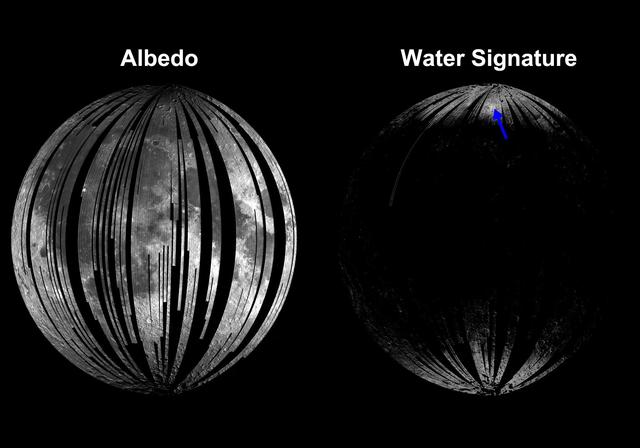
Ver en NASA ↗This image of the moon is from NASA Moon Mineralogy Mapper on the Indian Space Research Organization Chandrayaan-1 mission. It is a three-color composite of reflected near-infrared radiation from the sun.
Ver en NASA ↗This look at the complex surface of Jupiter's moon Ganymede came from NASA's Juno mission during a close pass by the giant moon in June 2021.
Ver en NASA ↗art001e002070 (Dec. 5, 2022) On flight day 20 of the Artemis I mission, Orion captured the Moon on the day of return powered flyby. The burn, which lasted 3 minutes, 27 seconds, committed the spacecraft to a Dec. 11 splashdown.
Ver en NASA ↗art001e002071 (Dec. 5, 2022) On flight day 20 of the Artemis I mission, Orion captured the Moon on the day of return powered flyby. The burn, which lasted 3 minutes, 27 seconds, committed the spacecraft to a Dec. 11 splashdown.
Ver en NASA ↗art001e001934 (Dec. 2, 2022) A camera mounted on one of Orion’s four solar arrays captured this image of the Moon on flight day 17 of the 25.5-day Artemis I mission from a distance of more than 222,000 miles. Orion has exited the distant lunar orbit and is he…
Ver en NASA ↗art001e002069 (Dec. 5, 2022) On flight day 20 of the Artemis I mission, Orion captured the Moon on the day of return powered flyby. The burn, which lasted 3 minutes, 27 seconds, committed the spacecraft to a Dec. 11 splashdown.
Ver en NASA ↗art001e002067 (Dec. 5, 2022) On flight day 20 of the Artemis I mission, Orion captured the Moon on the day of return powered flyby. The burn, which lasted 3 minutes, 27 seconds, committed the spacecraft to a Dec. 11 splashdown.
Ver en NASA ↗085 moon and jem 250B
Ver en NASA ↗Jim Green (second from left), director, Planetary Science Division, Science Mission Directorate at NASA Headquarters in Washington discusses NASA’s findings of water molecules in the polar regions of the moon at a press conference at NASA Headquarters, Septem…
Ver en NASA ↗A panel including, from left to right, NASA Administrator Jared Isaacman, acting associate administrator for NASA's Exploration Systems Development Mission Directorate, Lori Glaze, and NASA Moon Base Program Executive, Carlos Garcia-Galan, answer questions du…
Ver en NASA ↗Side-by-side images depict NASA's Curiosity rover (left) and a moon buggy driven during the Apollo 16 mission.
Ver en NASA ↗A nearly full Moon sets as the space shuttle Discovery sits atop Launch pad 39A at the Kennedy Space Center in Cape Canaveral, Florida, Wednesday, March 11, 2009. Photo Credit: (NASA/Bill Ingalls)
Ver en NASA ↗The plumes of Enceladus continue to gush icy particles into Saturn orbit, making this little moon one of a select group of geologically active bodies in the solar system
Ver en NASA ↗The terminator region of Titania, one of Uranus five large moons, was captured in this Voyager 2 image obtained in the early morning hours of Jan. 24, 1986.
Ver en NASA ↗Few large craters are to be found in the wrinkled terrain of Enceladus, where the surface has been reworked by geologic processes presumably resulting from the moon inner warmth
Ver en NASA ↗The shadow of the moon Enceladus darkens a small portion of the swirling clouds on Saturn in this image captured by NASA Cassini spacecraft. Enceladus itself is not visible in this view.
Ver en NASA ↗Below a darkened Enceladus, a plume of water ice is backlit in this view of one of Saturn most dramatic moons. This image was captured by NASA Cassini spacecraft.
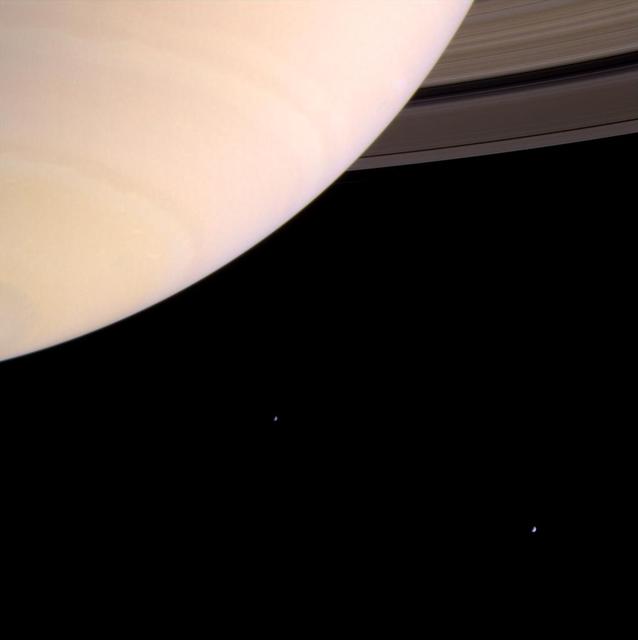
Ver en NASA ↗The moons visible in this image from NASA Cassini spacecraft, Pandora and Atlas, are quite small by astronomical standards, but the rings are also enormous. From one side of the planet to the other, the A ring stretches over 170,000 miles 270,000 km.
Ver en NASA ↗Contenido y metadatos proporcionados por la NASA Image and Video Library.