





/NASA’s%20Artemis%20III%20Announcement%20(Official%20NASA%20Trailer)~thumb.jpg)
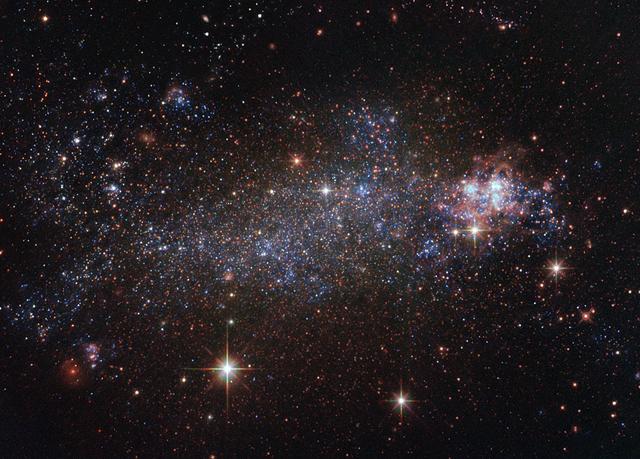

This striking NASA/ESA Hubble Space Telescope image captures the galaxy UGC 477, located just over 110 million light-years away in the constellation of Pisces (The Fish). UGC 477 is a low surface brightness (LSB) galaxy. First proposed in 1976 by Mike Disney…
Ver en NASA ↗🚀 Biblioteca espacial oficial
Imágenes y vídeos de NASA
Explora el catálogo multimedia público de NASA sin salir de TuPortalNews.
Explora temas destacados
Selecciona un tema o realiza una búsqueda personalizada.
629 resultados en NASA
Several thousand years ago, a star some 160,000 light-years away from us exploded, scattering stellar shrapnel across the sky. The aftermath of this energetic detonation is shown here in this striking image from the NASA/ESA Hubble Space Telescope’s Wide Fiel…
Ver en NASA ↗Some astronomical objects have endearing or quirky nicknames, inspired by mythology or their own appearance. Take, for example, the constellation of Orion (The Hunter), the Sombrero Galaxy, the Horsehead Nebula, or even the Milky Way. However, the vast majori…
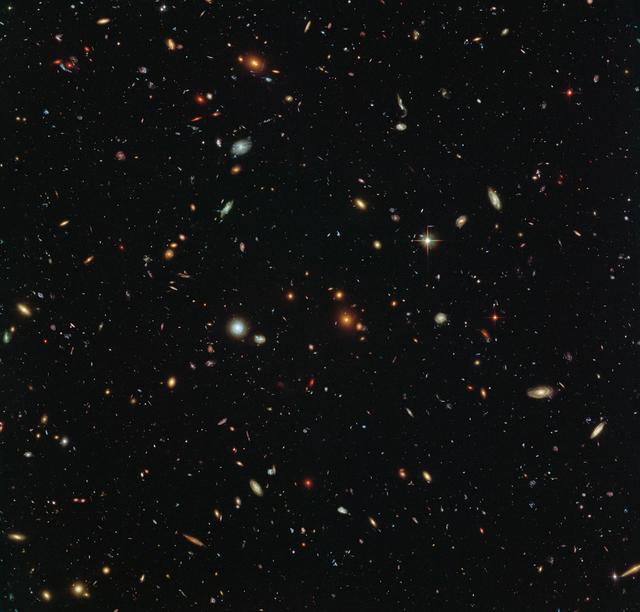
Ver en NASA ↗At the center of this amazing Hubble image is the elliptical galaxy NGC 3610. Surrounding the galaxy are a wealth of other galaxies of all shapes. There are spiral galaxies, galaxies with a bar in their central regions, distorted galaxies and elliptical galax…
Ver en NASA ↗Tidal disruption event Every galaxy has a black hole at its center. Usually they are quiet, without gas accretions, like the one in our Milky Way. But if a star creeps too close to the black hole, the gravitational tides can rip away the star’s gaseous matter…
Ver en NASA ↗Despite its unassuming appearance, the edge-on spiral galaxy captured in the left half of this NASA/ESA Hubble Space Telescope image is actually quite remarkable. Located about one billion light-years away in the constellation of Eridanus, this striking gala…
Ver en NASA ↗This image from NASA Spitzer Space Telescope, shows the wispy filamentary structure of Henize 206, is a four-color composite mosaic created by combining data from an infrared array camera IRAC.
Ver en NASA ↗NASA Spitzer Space Telescope, formerly known as the Space Infrared Telescope Facility, has captured in stunning detail the spidery filaments and newborn stars of theTarantula Nebula, a rich star-forming region also known as 30 Doradus.
Ver en NASA ↗The NASA/ESA Hubble Space Telescope has snapped the best ever image of the Antennae Galaxies. Hubble has released images of these stunning galaxies twice before, once using observations from its Wide Field and Planetary Camera 2 (WFPC2) in 1997, and again in …
Ver en NASA ↗Using NASA’s Hubble Space Telescope, astronomers have captured for the first time snapshots of fledging white dwarf stars beginning their slow-paced, 40-million-year migration from the crowded center of an ancient star cluster to the less populated suburbs. …
Ver en NASA ↗This shining disk of a spiral galaxy sits approximately 25 million light-years away from Earth in the constellation of Sculptor. Named NGC 24, the galaxy was discovered by British astronomer William Herschel in 1785, and measures some 40,000 light-years acros…
Ver en NASA ↗This NASA/European Space Agency (ESA) Hubble Space Telescope picture shows a galaxy named SBS 1415+437 (also called SDSS CGB 12067.1), located about 45 million light-years from Earth. SBS 1415+437 is a Wolf-Rayet galaxy, a type of star-bursting galaxy with an…
Ver en NASA ↗This NASA/ESA Hubble Space Telescope image shows the spiral galaxy NGC 4845, located over 65 million light-years away in the constellation of Virgo (The Virgin). The galaxy’s orientation clearly reveals the galaxy’s striking spiral structure: a flat and dust-…
Ver en NASA ↗Image release September 2, 2010 ABOUT THIS IMAGE: This image shows the entire region around supernova 1987A. The most prominent feature in the image is a ring with dozens of bright spots. A shock wave of material unleashed by the stellar blast is slamming …
Ver en NASA ↗Despite being less famous than their elliptical and spiral galactic cousins, irregular dwarf galaxies, such as the one captured in this NASA/ESA Hubble Space Telescope image, are actually one of the most common types of galaxy in the universe. Known as UGC 44…
Ver en NASA ↗Most galaxies are clumped together in groups or clusters. A neighboring galaxy is never far away. But this galaxy, known as NGC 6503, has found itself in a lonely position, at the edge of a strangely empty patch of space called the Local Void. The Local Void…
Ver en NASA ↗This artist map of the Milky Way shows the location of one of the farthest known exoplanets, lying 13,000 light-years away. Most of the thousands of exoplanets discovered to date are closer to our solar system, as indicated by the pink/orange areas.
Ver en NASA ↗Just in time for the release of the movie “Star Wars Episode VII: The Force Awakens,” NASA’s Hubble Space Telescope has photographed what looks like a cosmic, double-bladed lightsaber. In the center of the image, partially obscured by a dark, Jedi-like cloak…
Ver en NASA ↗This galaxy has a far more exciting and futuristic classification than most — it hosts a megamaser. Megamasers are intensely bright, around 100 million times brighter than the masers found in galaxies like the Milky Way. The entire galaxy essentially acts as …
Ver en NASA ↗NASA image release January 10, 2011 In this image by NASA's Hubble Space Telescope, an unusual, ghostly green blob of gas appears to float near a normal-looking spiral galaxy. The bizarre object, dubbed Hanny's Voorwerp (Hanny's Object in Dutch), is the onl…
Ver en NASA ↗NASA image acquired August 31, 2010 To see a detail of this image go to: www.flickr.com/photos/gsfc/4971318856/ In this natural-color image from August 31, 2010, the ocean’s canvas swirls with turquoise, teal, navy, and green, the abstract art of the natura…
Ver en NASA ↗This image from NASA Spitzer Space Telescope shows an exceptionally bright source of radio emission in the constellation Cynus in a steller nursery called DR21.
Ver en NASA ↗NASA image acquired August 31, 2010 To see the full view of this image go to: www.flickr.com/photos/gsfc/4970549945 In this natural-color image from August 31, 2010, the ocean’s canvas swirls with turquoise, teal, navy, and green, the abstract art of the na…
Ver en NASA ↗Shown here in a new image taken with the Advanced Camera for Surveys (ACS) on board the NASA/ESA Hubble Space Telescope is the globular cluster NGC 1783. This is one of the biggest globular clusters in the Large Magellanic Cloud, a satellite galaxy of our own…
Ver en NASA ↗Contenido y metadatos proporcionados por la NASA Image and Video Library.