





/NASA’s%20Artemis%20III%20Announcement%20(Official%20NASA%20Trailer)~thumb.jpg)
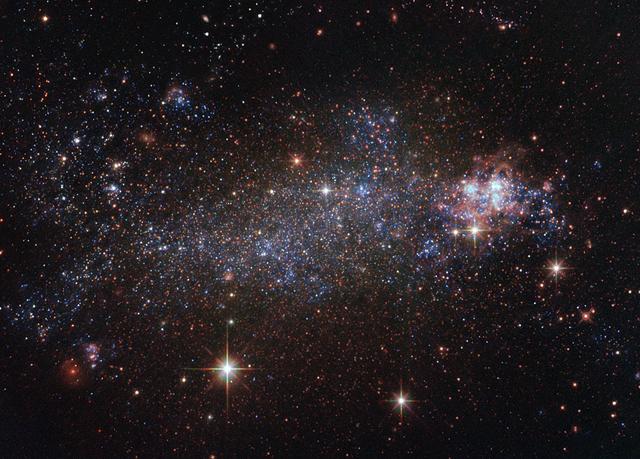

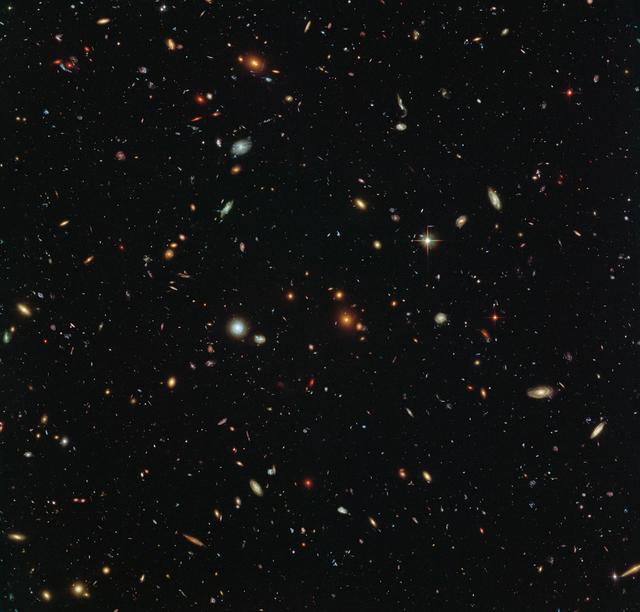
At first glance, this NASA/ESA Hubble Space Telescope image seems to show an array of different cosmic objects, but the speckling of stars shown here actually forms a single body — a nearby dwarf galaxy known as Leo A. Its few million stars are so sparsely di…
Ver en NASA ↗🚀 Biblioteca espacial oficial
Imágenes y vídeos de NASA
Explora el catálogo multimedia público de NASA sin salir de TuPortalNews.
Explora temas destacados
Selecciona un tema o realiza una búsqueda personalizada.
629 resultados en NASA
This artist's concept depicts the current record holder for the most luminous galaxy in the universe. The galaxy, named WISE J224607.57-052635.0, is erupting with light equal to more than 300 trillion suns. It was discovered by NASA's WISE.
Ver en NASA ↗NASA image captured March 27, 2012 NASA successfully launched five suborbital sounding rockets this morning from its Wallops Flight Facility in Virginia as part of a study of the upper level jet stream. The first rocket was launched at 4:58 a.m. EDT and each…
Ver en NASA ↗This NASA/ESA Hubble Space Telescope image shows Messier 96, a spiral galaxy just over 35 million light-years away in the constellation of Leo (The Lion). It is of about the same mass and size as the Milky Way. It was first discovered by astronomer Pierre Méc…
Ver en NASA ↗NASA's Spitzer Space Telescope imaged this cloud of gas and dust. The colors represent different wavelengths of infrared light and can reveal such features as places where radiation from stars had heated the surrounding material.
Ver en NASA ↗Image release January 11, 2012 A new Hubble Space Telescope image centers on the 100-million-solar-mass black hole at the hub of the neighboring spiral galaxy M31, or the Andromeda galaxy, one of the few galaxies outside the Milky Way visible to the naked ey…
Ver en NASA ↗NASA image captured March 27, 2012 NASA successfully launched five suborbital sounding rockets this morning from its Wallops Flight Facility in Virginia as part of a study of the upper level jet stream. The first rocket was launched at 4:58 a.m. EDT and each…
Ver en NASA ↗Release date: July 1, 2008 SN 1006 Supernova Remnant (Hubble) A delicate ribbon of gas floats eerily in our galaxy. A contrail from an alien spaceship? A jet from a black-hole? Actually this image, taken by NASA's Hubble Space Telescope, is a very thin sect…
Ver en NASA ↗For five years, Jeremy Harbeck has worked as a support scientist for NASA’s Operation IceBridge, an airborne mission to study polar ice. The data processing that he does typically takes place in an office at NASA’s Goddard Space Flight Center in Maryland. How…
Ver en NASA ↗Nearly all black holes come in one of two sizes: stellar mass black holes that weigh up to a few dozen times the mass of our sun or supermassive black holes ranging from a million to several billion times the sun’s mass. Astronomers believe that medium-sized …
Ver en NASA ↗This image, taken by the NASA/ESA Hubble Space Telescope, shows the colorful "last hurrah" of a star like our sun. The star is ending its life by casting off its outer layers of gas, which formed a cocoon around the star's remaining core. Ultraviole…
Ver en NASA ↗SEPTEMBER 24, 2013: Astronomers may have found the densest galaxy in the nearby universe. The galaxy, known as M60-UCD1, is located near a massive elliptical galaxy NGC 4649, also called M60, about 54 million light-years from Earth. This composite image shows…
Ver en NASA ↗A cluster of newborn stars herald their birth in this interstellar Valentine Day commemorative picture obtained with NASA Spitzer Space Telescope. These bright young stars are found in a rosebud-shaped and rose-colored nebulosity known as NGC 7129.
Ver en NASA ↗Hidden behind a shroud of dust in the constellation Cygnus is a stellar nursery called DR21 as seen by NASA Spitzer Space Telescope.
Ver en NASA ↗From objects as small as Newton's apple to those as large as a galaxy, no physical body is free from the stern bonds of gravity, as evidenced in this stunning picture captured by the Wide Field Camera 3 and Advanced Camera for Surveys onboard the NASA/ESA Hub…
Ver en NASA ↗Astronomers using NASA’s Hubble Space Telescope have uncovered surprising new clues about a hefty, rapidly aging star whose behavior has never been seen before in our Milky Way galaxy. In fact, the star is so weird that astronomers have nicknamed it “Nasty 1,…
Ver en NASA ↗NASA image release October 19, 2010 Though the universe is chock full of spiral-shaped galaxies, no two look exactly the same. This face-on spiral galaxy, called NGC 3982, is striking for its rich tapestry of star birth, along with its winding arms. The arms…
Ver en NASA ↗This image from the NASA/ESA Hubble Space Telescope shows the unusual galaxy IRAS 06076-2139, found in the constellation Lepus (The Hare). Hubble’s Wide Field Camera 3 (WFC3) and Advanced Camera for Surveys (ACS) instruments observed the galaxy from a distanc…
Ver en NASA ↗This delicate blue group of stars — actually an irregular galaxy named IC 3583 — sits some 30 million light-years away in the constellation of Virgo (The Virgin). It may seem to have no discernable structure, but IC 3583 has been found to have a bar of stars…
Ver en NASA ↗A panoramic view of a vast, sculpted area of gas and dust where thousands of stars are being born has been captured by NASA's Hubble Space Telescope.
Ver en NASA ↗The constellation of Ursa Major (The Great Bear) is home to Messier 101, the Pinwheel Galaxy. Messier 101 is one of the biggest and brightest spiral galaxies in the night sky. Like the Milky Way, Messier 101 is not alone, with smaller dwarf galaxies in its ne…
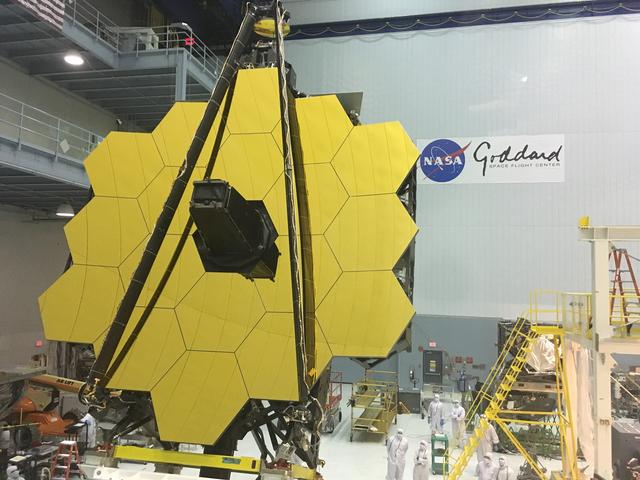
Ver en NASA ↗nside the world's largest clean room at NASA's Goddard Space Flight Center in Greenbelt, Md., engineers worked tirelessly to install another essential part of the James Webb Space Telescope - the Near Infrared Camera into the heart of the telescope. To compl…
Ver en NASA ↗This picture, taken by the NASA/ESA Hubble Space Telescope’s Wide Field Planetary Camera 2 (WFPC2), shows a galaxy known as NGC 6872 in the constellation of Pavo (The Peacock). Its unusual shape is caused by its interactions with the smaller galaxy that can b…
Ver en NASA ↗Observation Date: 1 pointing on Dec 4, 2000 and 9 pointings between Nov 18 and Dec 5, 2008. Distance Estimate: About 50 million light years away. This is a composite image of NGC 1068, one of the nearest and brightest galaxies containing a rapidly growing s…
Ver en NASA ↗Contenido y metadatos proporcionados por la NASA Image and Video Library.