





/NASA’s%20Artemis%20III%20Announcement%20(Official%20NASA%20Trailer)~thumb.jpg)

NASA image captured March 27, 2012 NASA successfully launched five suborbital sounding rockets this morning from its Wallops Flight Facility in Virginia as part of a study of the upper level jet stream. The first rocket was launched at 4:58 a.m. EDT and each…
Ver en NASA ↗🚀 Biblioteca espacial oficial
Imágenes y vídeos de NASA
Explora el catálogo multimedia público de NASA sin salir de TuPortalNews.
Explora temas destacados
Selecciona un tema o realiza una búsqueda personalizada.
629 resultados en NASA
This picture, spanning 50 light-years across, is a mosaic stitched from nine separate images from Hubble’s Wide Field Camera 3. The center of the Milky Way is located 27,000 light-years away. The “snowstorm” of stars in the image is just the tip of the iceber…
Ver en NASA ↗Image released April 19, 2013. Astronomers have used NASA's Hubble Space Telescope to photograph the iconic Horsehead Nebula in a new, infrared light to mark the 23rd anniversary of the famous observatory's launch aboard the space shuttle Discovery on April …
Ver en NASA ↗This NASA/ESA Hubble Space Telescope image shows the spiral galaxy NGC 4845, located over 65 million light-years away in the constellation of Virgo (The Virgin). The galaxy’s orientation clearly reveals the galaxy’s striking spiral structure: a flat and dust-…
Ver en NASA ↗NASA image captured March 27, 2012 NASA successfully launched five suborbital sounding rockets this morning from its Wallops Flight Facility in Virginia as part of a study of the upper level jet stream. The first rocket was launched at 4:58 a.m. EDT and each…
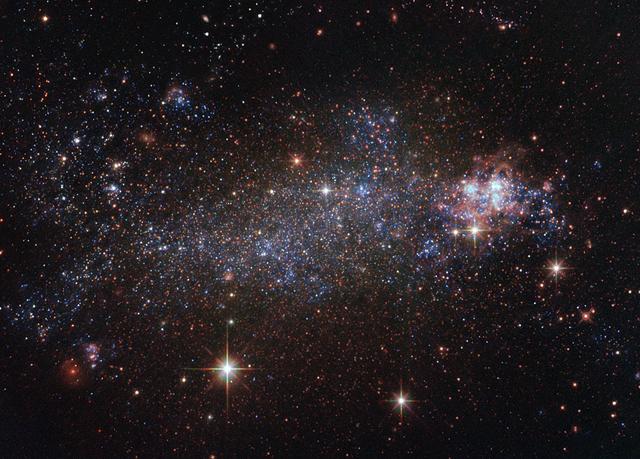
Ver en NASA ↗This image, courtesy of the NASA/ESA Hubble Space Telescope’s Advanced Camera for Surveys (ACS), captures the glow of distant stars within NGC 5264, a dwarf galaxy located just over 15 million light-years away in the constellation of Hydra (The Sea Serpent). …
Ver en NASA ↗NASA image release November 9, 2010 To view a video about this story go to: www.flickr.com/photos/gsfc/5162413062 From end to end, the gamma-ray bubbles extend 50,000 light-years, or roughly half of the Milky Way's diameter, as shown in this illustration. T…
Ver en NASA ↗This NASA/ESA Hubble Space Telescope image reveals the iridescent interior of one of the most active galaxies in our local neighbourhood — NGC 1569, a small galaxy located about eleven million light-years away in the constellation of Camelopardalis (The Giraf…
Ver en NASA ↗NASA image release December 5, 2011 This is an artist's concept of the fastest rotating star found to date. The massive, bright young star, called VFTS 102, rotates at a million miles per hour, or 100 times faster than our Sun does. Centrifugal forces from t…
Ver en NASA ↗So Coldplay isn't the only one to see a sky full of stars, these are 22K light-years away Located approximately 22,000 light-years away in the constellation of Musca (The Fly), this tightly packed collection of stars — known as a globular cluster — goes by t…
Ver en NASA ↗The galaxy, NGC 178 may be small, but it packs quite a punch. Measuring around 40,000 light-years across, its diameter is less than half that of the Milky Way, and it is accordingly classified as a dwarf galaxy. Despite its diminutive size, NGC 178 is busy fo…
Ver en NASA ↗NASA image captured March 27, 2012 NASA successfully launched five suborbital sounding rockets this morning from its Wallops Flight Facility in Virginia as part of a study of the upper level jet stream. The first rocket was launched at 4:58 a.m. EDT and each…
Ver en NASA ↗This is an artist's impression of how the very early universe (less than one billion years old) might have looked when it went through a voracious onset of star formation, converting primordial hydrogen into myriad stars at an unprecedented rate. The deepest …
Ver en NASA ↗This video shows SPHEREx's field of view as it scans across one section of sky inside the Large Magellanic Cloud, with rainbow colors representing the infrared wavelengths the telescope's detectors see.
Ver en NASA ↗Hidden behind a shroud of dust in the constellation Cygnus is an exceptionally bright source of radio emission called DR21 in this image from NASA Spitzer Space Telescope.
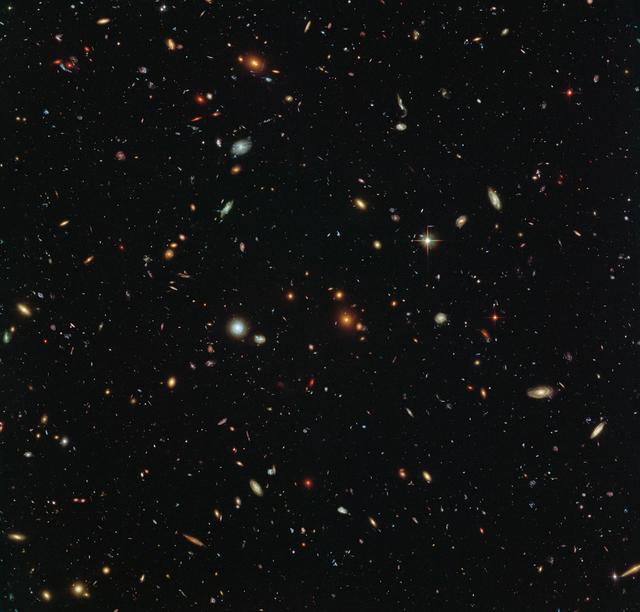
Ver en NASA ↗Peering deep into the early universe, this picturesque parallel field observation from the NASA/ESA Hubble Space Telescope reveals thousands of colorful galaxies swimming in the inky blackness of space. A few foreground stars from our own galaxy, the Milky Wa…
Ver en NASA ↗This galaxy is currently a hotbed of vigorous star formation. NGC 1569 is a starburst galaxy, meaning that — as the name suggests — it is bursting at the seams with stars, and is currently producing them at a rate far higher than that observed in most other g…
Ver en NASA ↗NASA image release November 9, 2010 To view a video about this story go to: www.flickr.com/photos/gsfc/5162413062 From end to end, the newly discovered gamma-ray bubbles extend 50,000 light-years, or roughly half of the Milky Way's diameter, as shown in thi…
Ver en NASA ↗In celebration of the 27th anniversary of the launch of NASA's Hubble Space Telescope on April 24, 1990, astronomers used the legendary telescope to take a portrait of a stunning pair of spiral galaxies. This starry pair offers a glimpse of what our Milky Way…
Ver en NASA ↗These delicate wisps of gas make up an object known as SNR B0519-69.0, or SNR 0519 for short. The thin, blood-red shells are actually the remnants from when an unstable progenitor star exploded violently as a supernova around 600 years ago. There are several …
Ver en NASA ↗Using NASA’s Hubble Space Telescope, astronomers have captured for the first time snapshots of fledging white dwarf stars beginning their slow-paced, 40-million-year migration from the crowded center of an ancient star cluster to the less populated suburbs. …
Ver en NASA ↗In 1900, astronomer Joseph Lunt made a discovery: Peering through a telescope at Cape Town Observatory, the British–South African scientist spotted this beautiful sight in the southern constellation of Grus (The Crane): a barred spiral galaxy now named IC 520…
Ver en NASA ↗NASA image captured March 27, 2012 NASA successfully launched five suborbital sounding rockets this morning from its Wallops Flight Facility in Virginia as part of a study of the upper level jet stream. The first rocket was launched at 4:58 a.m. EDT and each…
Ver en NASA ↗The subject of this Hubble image is NGC 5474, a dwarf galaxy located 21 million light-years away in the constellation of Ursa Major (The Great Bear). This beautiful image was taken with Hubble's Advanced Camera for Surveys (ACS). The term "dwarf galaxy&…
Ver en NASA ↗Contenido y metadatos proporcionados por la NASA Image and Video Library.