





/NASA’s%20Artemis%20III%20Announcement%20(Official%20NASA%20Trailer)~thumb.jpg)

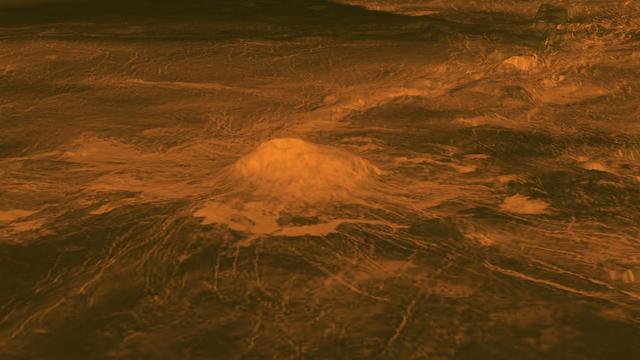
This comet-like tail, trending northeast from the volcanic structure, is a relatively radar-bright deposit. The volcano, with a base diameter of about 3 miles, is a local topographic high point that has slowed down northeast trending winds.
Ver en NASA ↗🚀 Biblioteca espacial oficial
Imágenes y vídeos de NASA
Explora el catálogo multimedia público de NASA sin salir de TuPortalNews.
Explora temas destacados
Selecciona un tema o realiza una búsqueda personalizada.
1.036 resultados en NASA
In this modeled image of ISON, the coma has been subtracted, leaving behind the nucleus. Credit: NASA, ESA, the Hubble Heritage Team (AURA/STScI) and Jian-Yang Li (Planetary Science Institute) -------- More details on Comet ISON: Comet ISON began its tri…
Ver en NASA ↗KENNEDY SPACE CENTER, FLA. -- The setting sun casts purple and pink shades in the sky as the launch tower on pad 17-A, Cape Canaveral Air Force Station, rolls back to reveal the Boeing Delta II rocket with NASA's Comet Nucleus Tour (CONTOUR) spacecraft attac…
Ver en NASA ↗KENNEDY SPACE CENTER, FLA. -- The Boeing Delta II rocket with NASA's Comet Nucleus Tour (CONTOUR) spacecraft attached is bathed in light as it sits on pad 17-A, Cape Canaveral Air Force Station. The launch is scheduled for 2:47 a.m. EDT July 3. Designed and …
Ver en NASA ↗KENNEDY SPACE CENTER, FLA. -- The Boeing Delta II rocket carrying NASA's Comet Nucleus Tour (CONTOUR) spacecraft streaks across the night sky above pad 17-A, Cape Canaveral Air Force Station. The launch took place at 2:47:41 a.m. EDT July 3. Designed and bui…
Ver en NASA ↗KENNEDY SPACE CENTER, FLA. - The Boeing Delta II rocket with NASA's Comet Nucleus Tour (CONTOUR) spacecraft attached is becoming visible as the launch tower is prepared for rollback. The launch is scheduled for 2:47 a.m. EDT July 3 from Cape Canaveral Air Fo…
Ver en NASA ↗KENNEDY SPACE CENTER, FLA. - Sunset-shaded clouds of purple and pink fill the sky as the launch tower on pad 17-A, Cape Canaveral Air Force Station, rolls back to reveal the Boeing Delta II rocket with NASA's Comet Nucleus Tour (CONTOUR) spacecraft attached. …
Ver en NASA ↗KENNEDY SPACE CENTER, FLA. -- The Boeing Delta II rocket with NASA's Comet Nucleus Tour (CONTOUR) spacecraft attached is visible as the launch tower is rolled back. The launch is scheduled for 2:47 a.m. EDT July 3 from Cape Canaveral Air Force Station, Fla. …
Ver en NASA ↗KENNEDY SPACE CENTER, FLA. -- After tower rollback, the Boeing Delta II rocket with NASA's Comet Nucleus Tour (CONTOUR) spacecraft attached is visible. The rocket exhibits several logos, including that of CONTOUR, Boeing and NASA. The launch is scheduled…
Ver en NASA ↗Comet (Artwork by Don Davis) Shoemaker Levy 9 impact on Jupiter (Artwork nucleus chunk view)
Ver en NASA ↗Pioneer Galileo mission trajectory artwork depicting radio signal from Earth to spacecraft to planet and comet crossing spacecrafts' orbit
Ver en NASA ↗On Oct. 9, 2013, Hubble observed comet ISON once again, when it was inside the orbit of Mars, about 177 million miles from Earth. This image shows that the comet was still intact despite some predictions that the fragile icy nucleus might disintegrate closer …
Ver en NASA ↗On April 30, NASA's Hubble Space Telescope observed Comet ISON again. The comet is in the upper middle, showing the long tail. Various galaxies and stars appear behind it. In this image, Hubble trained its telescope on the stars instead of following the com…
Ver en NASA ↗This image shows the initial ejecta that resulted when NASA Deep Impact probe collided with comet Tempel 1 at 10:52 p.m. Pacific time, July 3 1:52 a.m. Eastern time, July 4, 2005.
Ver en NASA ↗This radar image of asteroid 1999 RQ36 was obtained NASA Deep Space Network antenna in Goldstone, Calif. on Sept 23, 1999. NASA detects, tracks and characterizes asteroids and comets passing close to Earth using both ground- and space-based telescopes.
Ver en NASA ↗Images obtained by NASA EPOXI mission spacecraft show an active end of the nucleus of comet Hartley 2. Icy particles spew from the surface. Most of these particles are traveling with the nucleus; fluffy nowballs about 3 centimeters to 30 centimeters.
Ver en NASA ↗Observations from NASA Spitzer Space Telescope have revealed that mature planetary systems -- dusty disks of asteroids, comets and possibly planets -- are more frequent around close-knit twin, or binary, stars than single stars like our sun.
Ver en NASA ↗In this diagram, the Vega system, which was already known to have a cooler outer belt of comets orange, is compared to our solar system with its asteroid and Kuiper belts. The ring of warm, rocky debris was detected using NASA Spitzer Space Telescope,
Ver en NASA ↗This 3-D image shows the region where NASA Deep Impact mission sent a probe into the surface of comet Tempel 1 in 2005. This picture was taken six years after the Deep Impact collision. 3D glasses are necessary to view this image.
Ver en NASA ↗This image shows comet Tempel 1 six minutes before it ran over NASA Deep Impact probe at 10:52 a.m. Pacific time, July 3 1:52 a.m. Eastern time, July 4, 2005.
Ver en NASA ↗This image shows the initial ejecta that resulted when NASA Deep Impact probe collided with comet Tempel 1 at 10:52 p.m. Pacific time, July 3 1:52 a.m. Eastern time, July 4, 2005.
Ver en NASA ↗This image shows comet Tempel 1 six minutes before it ran over NASA Deep Impact probe at 10:52 a.m. Pacific time, July 3 1:52 a.m. Eastern time, July 4, 2005.
Ver en NASA ↗KENNEDY SPACE CENTER, FLA. -- The Boeing Delta II rocket nears a vertical position as it is lifted from the gantry. The rocket is the launch vehicle for the CONTOUR spacecraft, scheduled to launch July 1. CONTOUR will provide the first detailed look into the…
Ver en NASA ↗Comet Hale-Bopp was photographed in the constellation Andromeda by George Shelton, photographer for The Bionetics Corp., at 8:14 p.m. on March 31, 1997, from Merritt Island, Florida, close to the Kennedy Space Center. During this 24-hour period, Comet Hale-Bo…
Ver en NASA ↗Contenido y metadatos proporcionados por la NASA Image and Video Library.