





/NASA’s%20Artemis%20III%20Announcement%20(Official%20NASA%20Trailer)~thumb.jpg)

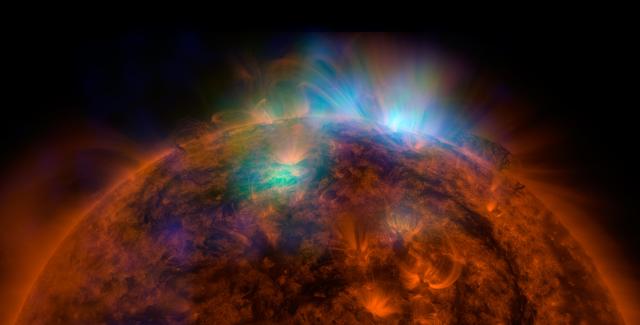
NASA's Solar Dynamics Observatory (SDO) zoomed in almost to its maximum level to watch tight, bright loops and much longer, softer loops shift and sway above an active region on the sun, while a darker blob of plasma in their midst was pulled about every whic…
Ver en NASA ↗🚀 Biblioteca espacial oficial
Imágenes y vídeos de NASA
Explora el catálogo multimedia público de NASA sin salir de TuPortalNews.
Explora temas destacados
Selecciona un tema o realiza una búsqueda personalizada.
6.539 resultados en NASA
A "transit of Venus" occurs when the planet Venus passes directly between the sun and the Earth. During the event, Venus will be seen from Earth as a small black sphere moving across the face of the sun. Such an event won’t occur again until the ye…
Ver en NASA ↗An instrument on our Solar Dynamics Observatory (SDO) captured its 100 millionth image of the sun. The instrument is the Atmospheric Imaging Assembly, or AIA, which uses four telescopes working parallel to gather eight images of the sun – cycling through 10 d…
Ver en NASA ↗Spectacular eruption: On June 7, 2011, SDO captured this image as a massive eruption lifted an enormous amount of cool, dark material into the corona. Most of that material fell back onto the sun, where the gravitational energy of the fall caused it to heat u…
Ver en NASA ↗This close-up image of the sun presents an active region in profile as it rotated out of view. We can observe both the bright arching field lines and smaller pieces of darker matter in their midst being pulled back and forth just above the Sun's surface over …
Ver en NASA ↗How did scientists know that NASA Voyager spacecraft entered interstellar space? Increase in the density of charged particles was the key piece of evidence. Our sun sits in a bubble, called the heliosphere, carved out by wind emitted from the hot sun.
Ver en NASA ↗This artist concept shows the planet catalogued as 2003UB313 at the lonely outer fringes of our solar system. Our Sun can be seen in the distance. The new planet is at least as big as Pluto and about three times farther away from the Sun than Pluto.
Ver en NASA ↗CAPSTONE, a microwave oven-sized CubeSat, will fly in cislunar space – the orbital space near and around the Moon. The mission will demonstrate an innovative spacecraft-to-spacecraft navigation solution at the Moon from a near rectilinear halo orbit slated fo…
Ver en NASA ↗While humans lives unfolded on Earth, NASA Mars Exploration Rover Opportunity paused in its southward trek and captured this photomosaic in approximate true color.
Ver en NASA ↗This image from NASA Mars Odyssey spacecraft of the northern plains of Mars shows a surface texture of hundreds of small mounds and numerous small impact craters.
Ver en NASA ↗New data from NASA Cassini spacecraft suggest that the shape of our solar system moving through the local Milky Way galaxy looks like a bubble -- or a rat -- traveling through a boa constrictor belly.
Ver en NASA ↗NASA Phoenix Mars Lander will open its solar arrays 20 minutes after it touches down on the surface of Mars.
Ver en NASA ↗A nearly full Rhea shines in the sunlight in this image from NASA Cassini spacecraft. Rhea 949 miles, or 1,527 kilometers across is Saturn second largest moon.
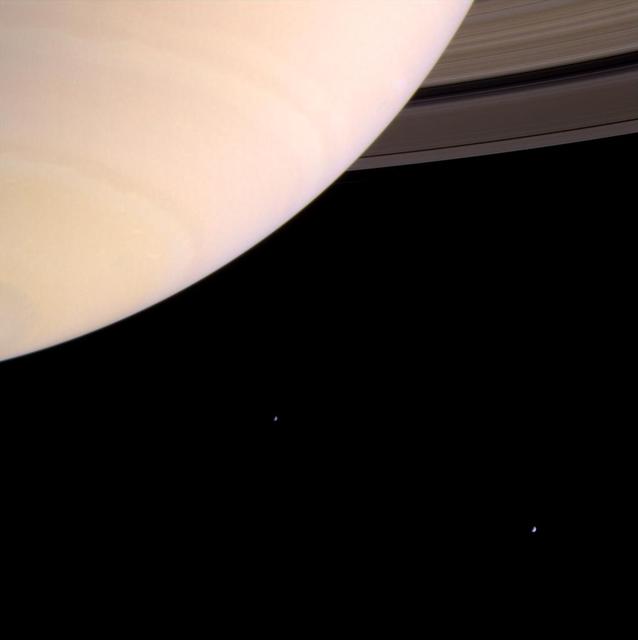
Ver en NASA ↗The dark shadows that drape Saturn northern latitudes are split by three familiar bright gaps
Ver en NASA ↗This artist concept shows NASA Voyager 1 spacecraft in a new region at the edge of our solar system where there are fewer low energy particles that originate from inside our solar system.
Ver en NASA ↗This image from a set of animations show NASA Voyager 1 spacecraft exploring a new region in our solar system called the magnetic highway.
Ver en NASA ↗This artist concept depicts NASA Voyager 1 spacecraft entering interstellar space. Interstellar space is dominated by the plasma, or ionized gas, that was ejected by the death of nearby giant stars millions of years ago.
Ver en NASA ↗This visual represents sounds captured of interstellar space by NASA Voyager 1 spacecraft. Voyager 1 plasma wave instrument detected the vibrations of dense interstellar plasma.
Ver en NASA ↗This composite image combines NASA Extreme Ultravoilet Imaging Telescope images from three wavelengths into one that reveals solar features unique to each wavelength.
Ver en NASA ↗This artist concept shows NASA Voyager spacecraft against a backdrop of stars.
Ver en NASA ↗Radio telescopes cannot see Voyager 1 in visible light, but rather see the spacecraft signal in radio light. This image of Voyager 1 signal on Feb. 21, 2013. At the time, Voyager 1 was 11.5 billion miles 18.5 billion kilometers away.
Ver en NASA ↗This artist concept shows the general locations of NASA two Voyager spacecraft. Voyager 1 top has sailed beyond our solar bubble into interstellar space. Voyager 2 bottom is still exploring the outer layer of the solar bubble.
Ver en NASA ↗This artist concept shows the outer layers of our solar bubble, or heliosphere, and nearby interstellar space. NASA Voyager 1 is currently exploring a region of interstellar space.
Ver en NASA ↗The image taken by the Oschin Schmidt Telescope, shows the star AC +79 3888, also known as Gliese 445. NASA Voyager 1 spacecraft, which is on a trajectory out of our solar system, is headed toward an encounter with AC +79 3888 circled in red.
Ver en NASA ↗Contenido y metadatos proporcionados por la NASA Image and Video Library.