





/NASA’s%20Artemis%20III%20Announcement%20(Official%20NASA%20Trailer)~thumb.jpg)

Workers inside the Astrotech Space Operations Facility in Titusville, Florida, prepare NASA’s Lucy spacecraft for installation of the high gain antenna on Aug. 6, 2021. Lucy is scheduled to launch no earlier than Saturday, Oct. 16, on a United Launch Alliance…
Ver en NASA ↗🚀 Biblioteca espacial oficial
Imágenes y vídeos de NASA
Explora el catálogo multimedia público de NASA sin salir de TuPortalNews.
Explora temas destacados
Selecciona un tema o realiza una búsqueda personalizada.
3.592 resultados en NASA
Workers inside the Astrotech Space Operations Facility in Titusville, Florida, work to open and extend one of the solar arrays on NASA’s Lucy spacecraft on Aug. 19, 2021. Both solar arrays will be opened to make sure they operate correctly. In view installed …
Ver en NASA ↗Workers inside the Astrotech Space Operations Facility in Titusville, Florida, begin to extend one of the solar arrays on NASA’s Lucy spacecraft on Aug. 19, 2021. Both solar arrays will be opened to make sure they operate correctly. Lucy is scheduled to launc…
Ver en NASA ↗Workers inside the Astrotech Space Operations Facility in Titusville, Florida, prepare the high gain antenna for installation on NASA’s Lucy spacecraft on Aug. 6, 2021. Lucy is scheduled to launch no earlier than Saturday, Oct. 16, on a United Launch Alliance…
Ver en NASA ↗Workers assist as a crane lowers the high gain antenna for installation on NASA’s Lucy spacecraft inside the Astrotech Space Operations Facility in Titusville, Florida, on Aug. 6, 2021. Lucy is scheduled to launch no earlier than Saturday, Oct. 16, on a Unite…
Ver en NASA ↗Inside the Astrotech Space Operations Facility in Titusville, Florida, the high gain antenna for NASA’s Lucy spacecraft is lifted by crane on Aug. 6, 2021. The antenna will be installed on Lucy. Lucy is scheduled to launch no earlier than Saturday, Oct. 16, o…
Ver en NASA ↗Workers assist as a crane lowers the high gain antenna for installation on NASA’s Lucy spacecraft inside the Astrotech Space Operations Facility in Titusville, Florida, on Aug. 6, 2021. Lucy is scheduled to launch no earlier than Saturday, Oct. 16, on a Unite…
Ver en NASA ↗Only one of the 37-foot-long (11.3-meter-long) arrays on NASA's Psyche spacecraft can be unfolded at a time during testing in JPL's High Bay 2 clean room.
Ver en NASA ↗An engineer examines a panel on a stowed solar array on NASA's Psyche spacecraft prior to a deployment test in a clean at JPL. The panels are designed to work in low-light conditions, far from the Sun.
Ver en NASA ↗Before a deployment test in a clean room at JPL, engineers examine one of Psyche's two solar arrays. The arrays are folded and stowed flush with the chassis, as shown here, before launch and then deployed in flight.
Ver en NASA ↗These images from NASA Dawn spacecraft show Caparronia crater on asteroid Vesta.
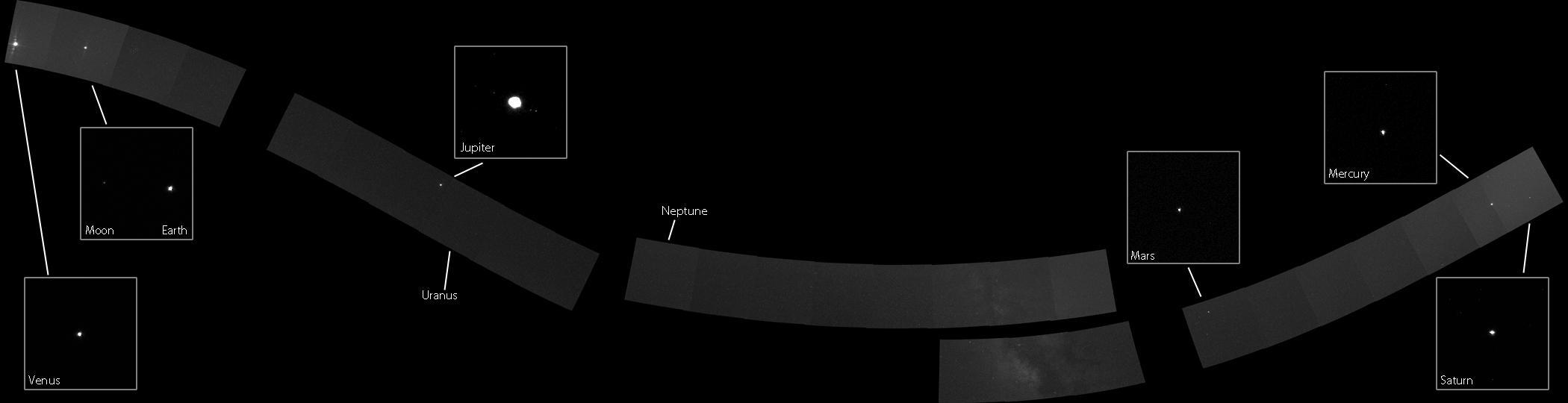
Ver en NASA ↗This is an artist conception of a solar-system montage of the eight planets, a comet and an asteroid.
Ver en NASA ↗These images from NASA Dawn spacecraft show Sextilia crater on asteroid Vesta.
Ver en NASA ↗This image from NASA Dawn spacecraft is located in asteroid Vesta Caparronia quadrangle.
Ver en NASA ↗NASA Dawn spacecraft of asteroid Vesta shows the apparent brightness of asteroid Vesta surface. Aquilia crater, located in Vesta Pinaria quadrangle, is the large crater that dominates the top part of both images.
Ver en NASA ↗This image of asteroid Vesta, from NASA Dawn spacecraft, calculated from a shape model, shows a tilted view of the topography of the south polar region. This perspective removes the overall curvature of Vesta, as if the giant asteroid were flat and not
Ver en NASA ↗Hubble Wide Field Camera 3 observed the potato-shaped asteroid in preparation for the visit by NASA Dawn spacecraft in 2011. This is one frame from a movie showing the difference in brightness and color on the asteroid surface.
Ver en NASA ↗This image was the most detailed picture of then recently discovered natural satellite of asteroid 243 Ida taken by the Galileo Solid-State Imaging camera during its encounter with the asteroid on August 28, 1993.
Ver en NASA ↗This image obtained by the framing camera on NASA Dawn spacecraft shows the south pole of the giant asteroid Vesta. Scientists are discussing whether the circular structure that covers most of this image originated by a collision with another asteroid.
Ver en NASA ↗Studying meteorites from the asteroid Vesta helps scientists understand the event known as the lunar cataclysm, when a repositioning of the gas giant planets destabilized a portion of the asteroid belt and triggered a solar-system-wide bombardment.
Ver en NASA ↗Artist concept of NASA Dawn spacecraft. The giant asteroid Vesta, Dawn next destination, is on the lower left. Another larger asteroid and Dawn second destination, Ceres, is on the upper right.
Ver en NASA ↗This image of the giant asteroid Vesta obtained by NASA Dawn spacecraft shows numerous impact craters illustrate the asteroid violent youth. You need 3D glasses to view this image.
Ver en NASA ↗This image from NASA Dawn spacecraft shows a fresh scarp rimmed crater with many boulders on asteroid Vesta crater floor. These boulders have diameters of 100-200m, which is roughly the size of many asteroids.
Ver en NASA ↗The shadowy outlines of the terrain in Vesta northern region are visible in this image from NASA Dawn spacecraft. The image comes from the last sequence of images Dawn obtained of the giant asteroid Vesta as it departed the giant asteroid.
Ver en NASA ↗Contenido y metadatos proporcionados por la NASA Image and Video Library.