





/NASA’s%20Artemis%20III%20Announcement%20(Official%20NASA%20Trailer)~thumb.jpg)

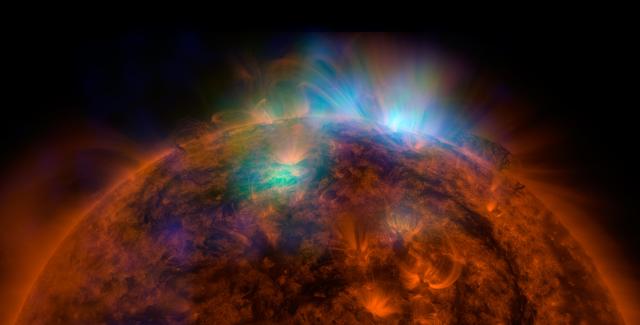
Observations of spicules from NASA's Solar Dynamics Observatory, or SDO. Over a few hours observation of the northern pole area of the Sun in extreme ultraviolet light (Aug. 3, 2010), we can see a continual frenzy of spicules.
Ver en NASA ↗🚀 Biblioteca espacial oficial
Imágenes y vídeos de NASA
Explora el catálogo multimedia público de NASA sin salir de TuPortalNews.
Explora temas destacados
Selecciona un tema o realiza una búsqueda personalizada.
399 resultados en NASA
NASA Science Live: New Discoveries from Our Mission to Touch the Sun [Episode 12]
Ver en NASA ↗Holly Gilbert, NASA GSFC solar scientist, explains a model of magnetic fields on the sun.
Ver en NASA ↗Solar activity is heating up, and NASA’s SunRISE mission is getting ready to reveal the turbulent workings of our nearest star like never before. The Sun Radio Interferometer Space Experiment – or SunRISE – is an array of six toaster-sized spacecraft that wil…
Ver en NASA ↗On Monday, August 21, 2017, our nation will be treated to a total eclipse of the sun.
Ver en NASA ↗Highlights from the Solar Dynamics Observatory's five years of watching the sun.
Ver en NASA ↗A comet's journey through the solar syste is perilous and violent. Before it reaches Mars - at some 230 million miles away from the sun - the radiation of the sun begins to cook off the frozen water ice directly into gas.
Ver en NASA ↗The sun emitted three mid-level solar flares on July 22-23, 2016, the strongest peaking at 1:16 am EDT on July 23. The sun is currently in a period of low activity, moving toward what's called solar minimum when there are few to no solar eruptions – so these …
Ver en NASA ↗Observations of the M class flare on August 24, 2014 NASA's Solar Dynamics Observatory and STEREO.
Ver en NASA ↗A web short about the multi-spacecraft observations of the March 29, 2014 X-class flare.
Ver en NASA ↗At any given moment, as many as 10 million wild jets of solar material burst from the sun’s surface. They erupt as fast as 60 miles per second, and can reach lengths of 6,000 miles before collapsing. These are spicules, and despite their grass-like abundance,…
Ver en NASA ↗Get ready to view the solar eclipse with these helpful safety tips. No one should ever look directly at the sun, even during an eclipse. Many options for indirect viewing are outlined in this video.
Ver en NASA ↗Number 2 in the Top 5 Solar Discoveries is the finding of the 'squashed' heliosphere when Voyager 1 and 2 crossed the bubble of solar wind at different distances from the sun. This led to a change in the way we see the shape of our heliosphere.
Ver en NASA ↗The sun is always changing and NASA's Solar Dynamics Observatory is always watching. Launched on Feb. 11, 2010, SDO keeps a 24-hour eye on the entire disk of the sun, with a prime view of the graceful dance of solar material coursing through the sun's atmosph…
Ver en NASA ↗NASA scientists answer some common questions about the sun, space weather, and how they affect the Earth.
Ver en NASA ↗NASA scientists answer some common questions about the sun, space weather, and how they affect the Earth.
Ver en NASA ↗An active region on the sun — an area of intense and complex magnetic fields — has rotated into view on the sun and seems to be growing rather quickly in this video captured by NASA’s Solar Dynamics Observatory between July 5-11, 2017. Such sunspots are a com…
Ver en NASA ↗. Observations of spicules from NASA's Interface Region Imaging Spectrograph, or IRIS.
Ver en NASA ↗On Sept. 13, 2015, as NASA’s Solar Dynamics Observatory, or SDO, kept up its constant watch on the sun, its view was photobombed not once, but twice. Just as the moon came into SDO’s field of view on a path to cross the sun, Earth entered the picture, blockin…
Ver en NASA ↗The Solar Dynamics Observatory, or SDO, has now captured nearly seven years worth of ultra-high resolution solar footage. This time lapse shows that full run from two of SDO's instruments. The large orange sun is visible light captured by the Helioseismic and…
Ver en NASA ↗On July 5, 2017, NASA’s Solar Dynamics Observatory watched AR26665, an active region — an area of intense and complex magnetic fields — rotate into view on the sun. The satellite continued to track the region as it grew and eventually rotated across the sun a…
Ver en NASA ↗An animation of space shuttle Atlantis in orbit as it comes out of the Sun's glare. The camera passes over the shuttle's main engines to view Hubble in the cargo bay. Animation of the space shuttle Atlantis with the Hubble Space Telescope berthed in its cargo…
Ver en NASA ↗Where does the solar system end? It all depends on the criteria you are using. Based on where the planets end, you could say it's Neptune and the Kuiper Belt. If you measure by edge of the sun's magnetic fields, the end is the heliosphere. If you judge by the…
Ver en NASA ↗On Feb. 11, 2010, NASA launched an unprecedented solar observatory into space. The Solar Dynamics Observatory (SDO) flew up on an Atlas V rocket, carrying instruments that scientists hoped would revolutionize observations of the sun. If all went according to …
Ver en NASA ↗Contenido y metadatos proporcionados por la NASA Image and Video Library.