





/NASA’s%20Artemis%20III%20Announcement%20(Official%20NASA%20Trailer)~thumb.jpg)

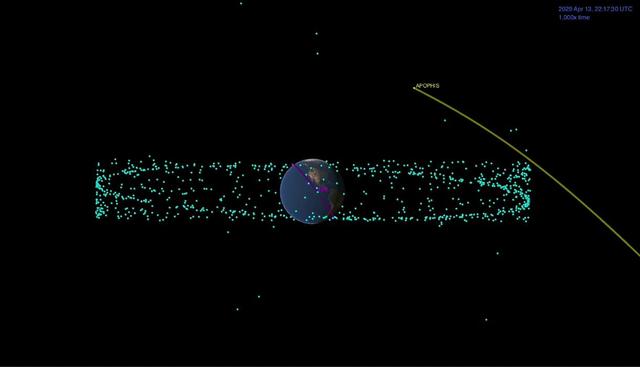
Results from NASA NEOWISE survey find that more potentially hazardous asteroids, or PHAs, are closely aligned with the plane of our solar system than previous models suggested.
Ver en NASA ↗🚀 Biblioteca espacial oficial
Imágenes y vídeos de NASA
Explora el catálogo multimedia público de NASA sin salir de TuPortalNews.
Explora temas destacados
Selecciona un tema o realiza una búsqueda personalizada.
7.273 resultados en NASA
Our solar system features eight planets, seen in this artist’s diagram. This representation is intentionally fanciful, as the planets are depicted far closer together than they really are.
Ver en NASA ↗As the solar wind flows from the sun, it creates a bubble in space known as the heliosphere around our solar system. The heliosphere is the region of space under the influence of our sun.
Ver en NASA ↗This artist's concept puts solar system distances -- and the travels of NASA's Voyager 2 spacecraft -- in perspective.
Ver en NASA ↗NASA Spitzer Space Telescope observed a fledgling solar system like the one depicted in this artist concept, and discovered deep within it enough water vapor to fill the oceans on Earth five times.
Ver en NASA ↗Detailed measurements of the physical properties of the seven rocky TRAPPIST-1 planets and the four terrestrial planets in our solar system help scientists find similarities and differences between the two planet families.
Ver en NASA ↗This narrow-angle color image of the Earth, dubbed Pale Blue Dot, is a part of the first ever portrait of the solar system taken by NASA’s Voyager 1.
Ver en NASA ↗This artist's illustration shows the comet 'Oumuamua racing toward the outskirts of our solar system.
Ver en NASA ↗All seven planets discovered in orbit around the red dwarf star TRAPPIST-1 could easily fit inside the orbit of Mercury, the innermost planet of our solar system.
Ver en NASA ↗This artist concept shows the planet catalogued as 2003UB313 at the lonely outer fringes of our solar system. Our Sun can be seen in the distance. The new planet is at least as big as Pluto and about three times farther away from the Sun than Pluto.
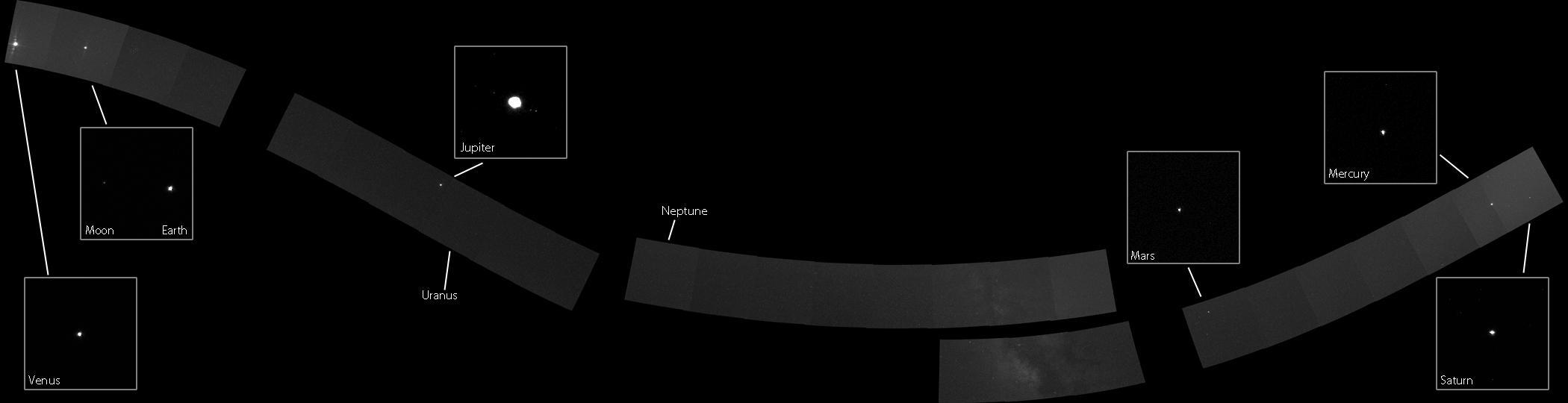
Ver en NASA ↗The cameras of Voyager 1 on Feb. 14, 1990, pointed back toward the sun and took a series of pictures of the sun and the planets, making the first ever portrait of our solar system as seen from the outside.
Ver en NASA ↗This graph presents known properties of the seven TRAPPIST-1 exoplanets (labeled b through h), showing how they stack up to the inner rocky worlds in our own solar system.
Ver en NASA ↗NASA’s Lewis Research Center conducted extensive research programs in the 1960s and 1970s to develop systems that provide electrical power in space. One system, the Brayton cycle engine, converted solar thermal energy into electrical power. This system operat…
Ver en NASA ↗Radar images of the binary asteroid 2017 YE5 from NASA's Goldstone Solar System Radar (GSSR). The observations, conducted on June 23, 2018, show two lobes, but do not yet show two separate objects.
Ver en NASA ↗This sunset photo shows NASA's Deep Space Station 14 (DSS-14), the 230-foot-wide (70-meter) antenna at the Goldstone Deep Space Communications Complex near Barstow, California.
Ver en NASA ↗TODD SCHNEIDER LOOKS UP FROM WORK AT THE DOOR OF T HE HIGH INTENSITY SOLAR ENVIRONMENT TEST SYSTEM IN BUILDING 4605. SCHNEIDER IS A PHYSICIST IN THE MATERIALS AND PROCESSES DEPARTMENT AT MSFC AND IS PRINCIPAL INVESTIGATOR FOR HISET.
Ver en NASA ↗Testing of the Solar Dynamic Collector for Space Freedom. The solar dynamic power system includes a solar concentrator, which collects sunlight; a receiver, which accepts and stores the concentrated solar energy and transfers this energy to a gas; a Brayton …
Ver en NASA ↗The Atmospheric Turbulence Measurement System booms extend forward from the Pathfinder-Plus solar wing as it soars over Rogers Dry Lake on its final flight.
Ver en NASA ↗Rectangular satellite with four solar panels extended and lit by the sun in space over the curve of the Earth.
Ver en NASA ↗This graph presents measured properties of the seven TRAPPIST-1 exoplanets.
Ver en NASA ↗All seven planets discovered in orbit around the red dwarf star TRAPPIST-1 could easily fit inside the orbit of Mercury, the innermost planet of our solar system. In fact, they would have room to spare.
Ver en NASA ↗These six narrow-angle color images were made from the first ever portrait of the solar system taken by NASA’s Voyager 1, which was more than 4 billion miles from Earth and about 32 degrees above the ecliptic.
Ver en NASA ↗Scientists think six icy moons in our solar system may currently host oceans of liquid water beneath their outer surfaces.
Ver en NASA ↗Square sail made up of four triangles seen at a sharp angle in space with the bright sun peeking under the edge of the Earth above.
Ver en NASA ↗Contenido y metadatos proporcionados por la NASA Image and Video Library.