





/NASA’s%20Artemis%20III%20Announcement%20(Official%20NASA%20Trailer)~thumb.jpg)

What are some skywatching highlights in January 2023? Some lovely groupings this month include the Moon with Mars, and later with Jupiter, and a close conjunction of Venus and Saturn. The brilliant stars of the Northern Hemisphere's winter sky are a dazzling …
Ver en NASA ↗🚀 Biblioteca espacial oficial
Imágenes y vídeos de NASA
Explora el catálogo multimedia público de NASA sin salir de TuPortalNews.
Explora temas destacados
Selecciona un tema o realiza una búsqueda personalizada.
48 resultados en NASA
NASA’s Stardust spacecraft has gathered dozens of images from its January fly-by of Comet Wild 2. (Pronounced Vilt 2). The spacecraft came within 147 miles of the comet taking the most detailed pictures ever captured. The pictures revealed a rugged surface …
Ver en NASA ↗Here are highlights from TESS's first year of science operations in a shorter, one-minute video. All exoplanet animations are illustrations.
Ver en NASA ↗Here are highlights from TESS's first year of science operations. All exoplanet animations are illustrations.
Ver en NASA ↗The Eta Aquarid meteor shower brings shooting stars before dawn, the Moon meets brilliant Venus after sunset, and May wraps up with a rare Blue Moon. Look to the early morning sky around May 5 to 6 for meteors from Halley’s Comet, though bright moonlight may …
Ver en NASA ↗NASA’s Kennedy Space Center Director Brian Hughes swore in the first phase of employees formerly from the Consolidated Operations, Management, Engineering, and Test (COMET) contract as new NASA civil servants on Monday, July 13, 2026, at NASA Kennedy in Flori…
Ver en NASA ↗NASA’s researchers have found the most distant object known to orbit our Sun. The planet-like object is three-fourths the size of Pluto and is in the coldest region of the Solar System. Temperatures never rise above minus 400 degrees Fahrenheit. Named Sedna…
Ver en NASA ↗Affectionately called the 'vomit comet' by astronauts and also known as the 'weightless wonder,' NASA's KC-135 aircraft is retiring after many years of valuable service. NASA created the Reduced Gravity Program in 1959 and the KC-135 was later chosen as the…
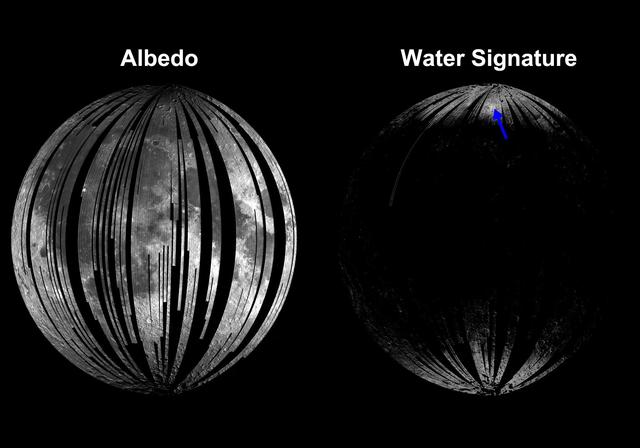
Ver en NASA ↗Data from the LADEE spacecraft reveal that the lunar surface is periodically releasing water.
Ver en NASA ↗2025 marks another year pushing the boundaries of scientific research aboard the International Space Station. This past year, over 750 investigations were conducted aboard the space station, supported by crewed missions and resupply vehicles delivering essent…
Ver en NASA ↗What are some skywatching highlights in May 2024? Mars and Saturn tussle with the Moon, Mercury makes a brief a.m. appearance, East Coasters can see red giant star Antares emerge from behind the Moon, and the eta Aquariid meteors peak on May 6th. Additional…
Ver en NASA ↗The film opens with an explanation of the electromagnetic spectrum. The limited capabilities of skyhook balloons and sounding rockets are used to illustrate the need for orbiting observatories. Reviews the planning, development, launching and function of the …
Ver en NASA ↗What are some skywatching highlights in December 2023? Clear skies will make for ideal viewing of the Geminid meteor shower, and grab you binoculars to search for asteroid Vesta. Additional information about topics covered in this episode of What's Up, alon…
Ver en NASA ↗What are some skywatching highlights in August 2020? See the Moon posing with various planets throughout the month, plus catch the peak of the annual Perseid meteor shower.
Ver en NASA ↗This visualization shows TESS's first field image and information about three early exoplanet detections. The locations of Pi Mensae c, LHS 3884b, and HD21749b appear, as well as information about the systems and animations of what the planets might look like.
Ver en NASA ↗Highlights from the March 11, 2025, launch of NASA’s SPHEREx space telescope, which will observe hundreds of millions of galaxies near and far, mapping the entire sky in 102 wavelengths that are invisible to the human eye. The spacecraft lifted off from Vande…
Ver en NASA ↗Contenido y metadatos proporcionados por la NASA Image and Video Library.