





/NASA’s%20Artemis%20III%20Announcement%20(Official%20NASA%20Trailer)~thumb.jpg)

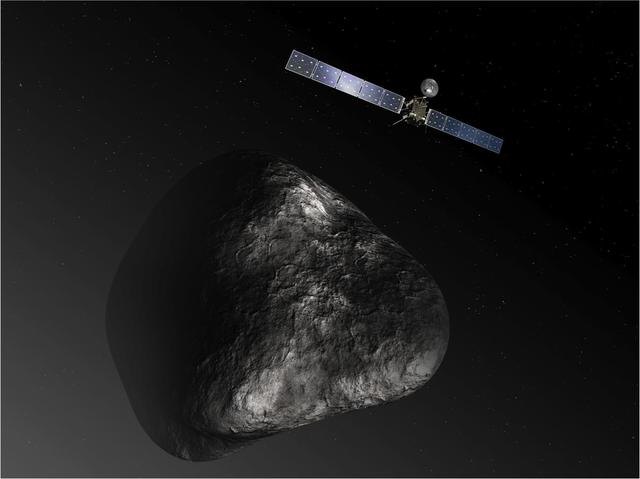
This graphic depicts the position of the Philae lander of the European Space Agency Rosetta mission in the context of topographic modeling of the surface of comet 67P/Churyumov-Gerasimenko nucleus.
Ver en NASA ↗🚀 Biblioteca espacial oficial
Imágenes y vídeos de NASA
Explora el catálogo multimedia público de NASA sin salir de TuPortalNews.
Explora temas destacados
Selecciona un tema o realiza una búsqueda personalizada.
1.036 resultados en NASA
A jagged horizon of the nucleus of comet 67P/Churyumov-Gerasimenko appears in this image taken by the navigation camera on the ESA Rosetta spacecraft during the second half of October 2014.
Ver en NASA ↗Four images taken by the ESA Rosetta spacecraft create a montage showing jets of dust and gas escaping from the nucleus of comet 67P/Churyumov–Gerasimenko.
Ver en NASA ↗This image shows comet C/2018 Y1 Iwamoto as imaged in multiple exposures of infrared light by NASA's Near-Earth Object Wide-field Survey Explorer (NEOWISE) space telescope.
Ver en NASA ↗This image of the coma of comet 67P/Churyumov-Gerasimenko, seen with ESAS OSIRIS onboard the Rosetta spacecraft, shows the hazy circular structure to the right and center of the coma is an artifact due to overexposure of the nucleus.
Ver en NASA ↗This image was taken by the Philae lander of the European Space Agency Rosetta mission when it was about 130 feet 40 meters above the surface of comet 67P/Churyumov-Gerasimenko during descent to the surface on Nov. 12, 2014.
Ver en NASA ↗This frame from an animated sequence shows the Rosetta mission Philae lander descending toward comet 67P/Churyumov-Gerasimenko not in frame on Nov. 12, 2014. The images are from the OSIRIS narrow-angle camera on the ESA Rosetta orbiter.
Ver en NASA ↗These radar images of comet P/2016 BA14 were taken on March 22, 2016, by scientists using an antenna of NASA Deep Space Network at Goldstone, CA. At the time, the comet was about 2.2 million miles 3.6 million kilometers from Earth.
Ver en NASA ↗This view from the OSIRIS instrument onboard ESA Rosetta spacecraft shows the nucleus of comet 67P/Churyumov-Gerasimernko from a distance of 1,210 miles 1950 kilometers.
Ver en NASA ↗An annotated mosaic from the Rosetta spacecraft shows Site J, the primary landing site on comet 67P/Churyumov-Gerasimenko for the mission Philae lander.
Ver en NASA ↗This image of comet 67P/Churyumov-Gerasimenko was obtained on October 30, 2014 by the OSIRIS scientific imaging system on the Rosetta spacecraft. The right half is obscured by darkness.
Ver en NASA ↗With the help of NASA Spitzer Space Telescope, astronomers have discovered that what was thought to be a large asteroid called Don Quixote is in fact a comet.
Ver en NASA ↗Comet 67P/Churyumov-Gerasimenko was imaged by ESA Rosetta spacecraft on July 20, 2014, from a distance of approximately 3,400 miles 5,500 kilometers. These three images were taken two hours apart.
Ver en NASA ↗A patch of relatively smooth ground on the nucleus surface of comet 67P/Churyumov-Gerasimenko appears in this image taken by the navigation camera on the European Space Agency Rosetta spacecraft in October 2014.
Ver en NASA ↗Some relatively rough terrain on the nucleus of comet 67P/Churyumov-Gerasimenko appears in this image taken by the navigation camera on the European Space Agency Rosetta spacecraft in the second half of October 2014.
Ver en NASA ↗The Philae lander of the European Space Agency Rosetta mission is safely on the surface of Comet 67P/Churyumov-Gerasimenko, as these first two images from the lander CIVA camera confirm. One of the lander three feet can be seen in the foreground.
Ver en NASA ↗Comet 67P/Churyumov-Gerasimenko by ESA Rosetta OSIRIS narrow-angle camera on August 3, 2014, from a distance of 177 miles 285 kilometers. The image resolution is 17 feet 5.3 meters per pixel.
Ver en NASA ↗This image was taken by the Optical, Spectroscopic, and Infrared Remote Imaging System, Rosetta main onboard scientific imaging system, on Sept. 10, 2014. Jets of cometary activity can be seen along almost the entire body of the comet.
Ver en NASA ↗This artist animation depicts one of the most widely accepted theories pertaining to the origin of comets. This image is courtesy of NASA Spitzer Science Center at the California Institute of Technology, Pasadena, Calif.
Ver en NASA ↗Captured March 12, 2010 The SOHO spacecraft captured a very bright, sungrazing comet as it rocketed towards the Sun (Mar. 12, 2010) and was vaporized. This comet is arguably the brightest comet that SOHO has observed since Comet McNaught in early 2007. The c…
Ver en NASA ↗This image showcases changes identified in high-resolution images of Comet 67P/Churyumov-Gerasimenko during more than two years of monitoring by ESA's Rosetta spacecraft.
Ver en NASA ↗This composite image was taken by the navigation camera during the close approach phase of Stardust Jan 2, 2004 flyby of comet Wild 2. Several large depressed regions can be seen. Comet Wild 2 is about five kilometers 3.1 miles in diameter.
Ver en NASA ↗These radar images of comet P/2016 BA14 were taken on March 23, 2016, by scientists using an antenna of NASA Deep Space Network at Goldstone, California. At the time, the comet was about 2.2 million miles 3.6 million kilometers from Earth.
Ver en NASA ↗A short-lived outburst from comet 67P/Churyumov-Gerasimenko was captured by Rosetta's OSIRIS narrow-angle camera on July 29, 2015. The image at left was taken at 13:06 Greenwich Mean Time (GMT) (6:06 a.m. PDT), and does not show any visible signs of the jet. …
Ver en NASA ↗Contenido y metadatos proporcionados por la NASA Image and Video Library.