





/NASA’s%20Artemis%20III%20Announcement%20(Official%20NASA%20Trailer)~thumb.jpg)

Taken about 40 minutes before NASA Mariner 10 made its close approach to Mercury on Sept. 21,1974, this picture shows a large double-ringed basin center of picture located in the planet south polar region
Ver en NASA ↗🚀 Biblioteca espacial oficial
Imágenes y vídeos de NASA
Explora el catálogo multimedia público de NASA sin salir de TuPortalNews.
Explora temas destacados
Selecciona un tema o realiza una búsqueda personalizada.
2.907 resultados en NASA
During its second encounter with Mercury on Sept. 21, 1974, NASA Mariner 10 took this picture of the planet South Polar Region. Many of the craters have denuded rims peppered by smaller craters.
Ver en NASA ↗This image was taken by NASA Mariner 10 during it first encounter with Mercury in 1974. The scarp forms a broad lobe whose southern end abuts against and follows closely the irregular contour of the crater wall.
Ver en NASA ↗Photographed are models of early rocketry: The Atlas Mercury, Redstone Mercury; and Saturn C-1.
Ver en NASA ↗Visit to Glenn Research Center at Lewis Field by Mercury 13 Astronaut Trainee, Wally Funk
Ver en NASA ↗Visit to Glenn Research Center at Lewis Field by Mercury 13 Astronaut Trainee, Wally Funk
Ver en NASA ↗Visit to Glenn Research Center at Lewis Field by Mercury 13 Astronaut Trainee, Wally Funk
Ver en NASA ↗Visit to Glenn Research Center at Lewis Field by Mercury 13 Astronaut Trainee, Wally Funk
Ver en NASA ↗Visit to Glenn Research Center at Lewis Field by Mercury 13 Astronaut Trainee, Wally Funk
Ver en NASA ↗Visit to Glenn Research Center at Lewis Field by Mercury 13 Astronaut Trainee, Wally Funk
Ver en NASA ↗Visit to Glenn Research Center at Lewis Field by Mercury 13 Astronaut Trainee, Wally Funk
Ver en NASA ↗Visit to Glenn Research Center at Lewis Field by Mercury 13 Astronaut Trainee, Wally Funk
Ver en NASA ↗S64-14286 (11 Feb. 1964) --- An artist's concept of Mercury: Medical effects; develop technology. Photo credit: NASA
Ver en NASA ↗Visit to Glenn Research Center at Lewis Field by Mercury 13 Astronaut Trainee, Wally Funk
Ver en NASA ↗Visit to Glenn Research Center at Lewis Field by Mercury 13 Astronaut Trainee, Wally Funk
Ver en NASA ↗Visit to Glenn Research Center at Lewis Field by Mercury 13 Astronaut Trainee, Wally Funk
Ver en NASA ↗At approximately 1.1 meters/pixel, this image is among the highest-resolution views MESSENGER has ever taken of the surface of Mercury.
Ver en NASA ↗Testing of Mercury Capsule Shape A by the Hydrodynamics Division of Langley. Joseph Shortal wrote (vol. 3, p. 19): The Hydrodynamics Division provided assistance in determining landing loads. In this connection, after PARD engineers had unofficially approach…
Ver en NASA ↗S62-01355 (1962) --- Project Mercury astronauts M. Scott Carpenter, prime pilot of the Mercury-Atlas 7 (MA-7) spaceflight, prepares to go through a water egress test. Astronaut Walter M. Schirra (back to camera), the backup MA-7 pilot is also present. Carpent…
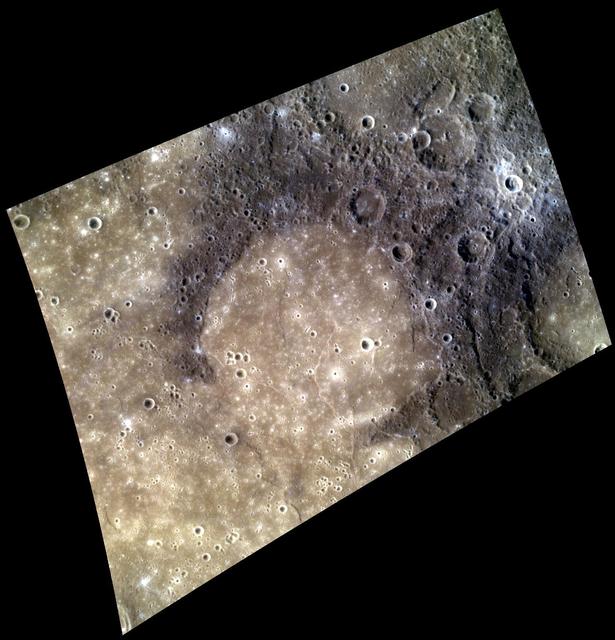
Ver en NASA ↗Hemingway crater is seen in this color view of Mercury surface as seen by NASA MESSENGER spacecraft. Hemingway is the 130-km 81-mile diameter crater with a relatively brown floor and small patch of dark blue in its center.
Ver en NASA ↗Lermontov crater was first observed by Mariner 10 and seen here by MESSENGER during its second flyby of Mercury. The crater floor is somewhat brighter than the exterior surface and is smooth with several irregularly shaped depressions.
Ver en NASA ↗In mid-February, before and after MESSENGER latest perihelion closest approach to the Sun, an imaging campaign was conducted to search for vulcanoids, small rocky bodies that have been postulated to exist in orbits between Mercury and the Sun.
Ver en NASA ↗The cliff-like feature crossing this image from NASA MESSENGER spacecraft from top to bottom is one of Mercury famed lobate scarps, and is called Pourquoi-Pas Rupes.
Ver en NASA ↗This false-color image of Mercury captured by NASA MESSENGER spacecraft shows the great Caloris impact basin, visible here as a large, circular, orange feature in the center of the picture.
Ver en NASA ↗Contenido y metadatos proporcionados por la NASA Image and Video Library.