





/NASA’s%20Artemis%20III%20Announcement%20(Official%20NASA%20Trailer)~thumb.jpg)

Technicians use an overheard crane to lift NASA’s PUNCH (Polarimeter to Unify the Corona and Heliosphere) spacecraft onto a work stand for testing operations at the Astrotech Processing Facility on Vandenberg Space Force Base in California on Sunday, Jan. 19,…
Ver en NASA ↗🚀 Biblioteca espacial oficial
Imágenes y vídeos de NASA
Explora el catálogo multimedia público de NASA sin salir de TuPortalNews.
Explora temas destacados
Selecciona un tema o realiza una búsqueda personalizada.
7.273 resultados en NASA
Technicians conduct testing operations on NASA’s PUNCH (Polarimeter to Unify the Corona and Heliosphere) spacecraft onto a work stand for testing operations at the Astrotech Processing Facility on Vandenberg Space Force Base in California on Sunday, Jan. 19, …
Ver en NASA ↗Technicians use an overheard crane to lift NASA’s PUNCH (Polarimeter to Unify the Corona and Heliosphere) spacecraft onto a work stand for testing operations at the Astrotech Processing Facility on Vandenberg Space Force Base in California on Sunday, Jan. 19,…
Ver en NASA ↗Technicians conduct testing operations on NASA’s PUNCH (Polarimeter to Unify the Corona and Heliosphere) spacecraft onto a work stand for testing operations at the Astrotech Processing Facility on Vandenberg Space Force Base in California on Sunday, Jan. 19, …
Ver en NASA ↗Technicians use an overheard crane to lift NASA’s PUNCH (Polarimeter to Unify the Corona and Heliosphere) spacecraft onto a work stand for testing operations at the Astrotech Processing Facility on Vandenberg Space Force Base in California on Sunday, Jan. 19,…
Ver en NASA ↗Technicians use an overheard crane to lift NASA’s PUNCH (Polarimeter to Unify the Corona and Heliosphere) spacecraft onto a work stand for testing operations at the Astrotech Processing Facility on Vandenberg Space Force Base in California on Sunday, Jan. 19,…
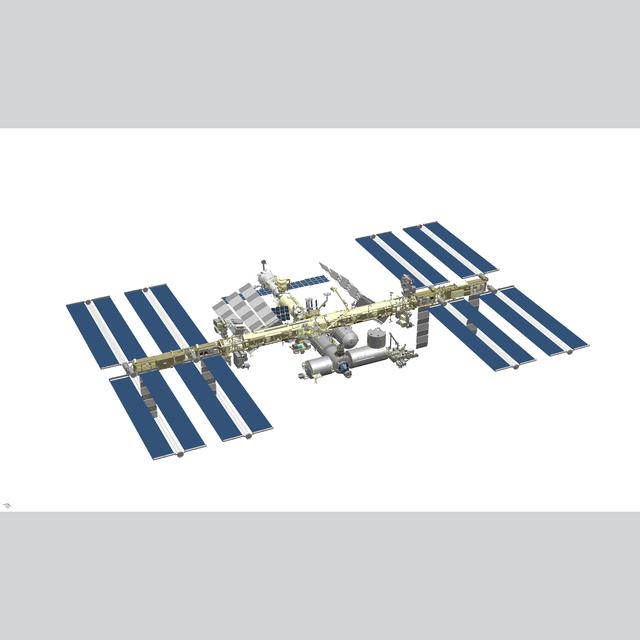
Ver en NASA ↗An overhead crane in the Space Station Processing Facility lifts a solar array as workers stand by to help guide it. The solar array will be installed onto the Integrated Equipment Assembly (IEA). A component of the International Space Station, the solar arra…
Ver en NASA ↗Workers rise to the occasion on accordion lifts as they oversee the movement of solar array in front of them. The solar array will be installed onto the Integrated Equipment Assembly (IEA). A component of the International Space Station, the solar array is th…
Ver en NASA ↗These four panels show the location of the newly discovered planet-like object, dubbed Sedna, which lies in the farthest reaches of our solar system.
Ver en NASA ↗Researchers at the Marshall Space Flight Center (MSFC) have designed, fabricated, and tested the first solar thermal engine, a non-chemical rocket engine that produces lower thrust but has better thrust efficiency than a chemical combustion engine. MSFC turne…
Ver en NASA ↗This photograph shows an overall view of the Solar Thermal Propulsion Test Facility at the Marshall Space Flight Center (MSFC). The 20-by 24-ft heliostat mirror, shown at the left, has dual-axis control that keeps a reflection of the sunlight on an 18-ft diam…
Ver en NASA ↗An artist concept illustrates the positions of the Voyager spacecraft in relation to structures formed around our Sun by the solar wind.
Ver en NASA ↗Daniel Bernatowicz, Chief of the Advanced Power Systems Branch at the National Aeronautics and Space Administration (NASA) Lewis Research Center, examines a 20-foot section of a solar mirror being fabricated in the Jig Bore Room of the Technical Services Buil…
Ver en NASA ↗Like most moons in the solar system, Tethys is covered by impact craters. Some craters bear witness to incredibly violent events, such as the crater Odysseus seen here at the right of this image from NASA Cassini spacecraft.
Ver en NASA ↗The solar arrays on NASA InSight lander are deployed in this test inside a clean room at Lockheed Martin Space Systems, Denver. This configuration is how the spacecraft will look on the surface of Mars. The image was taken on April 30, 2015.
Ver en NASA ↗Rhea, like many moons in the outer solar system, appears dazzlingly bright in full sunlight. This is the signature of the water ice that forms most of the moon surface, as seen by NASA's Cassini spacecraft.
Ver en NASA ↗CAPE CANAVERAL, Fla. – Part of the Constellation Program, the Ares I-X is the flight test vehicle for the Ares I, which is the essential core of a space transportation system that eventually will carry crewed missions back to the moon, on to Mars and out int…
Ver en NASA ↗Asteroid 1997 QK1 is shown to be an elongated, peanut-shaped near-Earth object in this series of 28 radar images obtained by the Deep Space Network's Goldstone Solar System Radar on Aug. 21, 2025.
Ver en NASA ↗iss052e004913 (June 19, 2017) --- The aurora and the night sky above Earth’s atmosphere are pictured from the space station. A portion of the station’s solar arrays and a pair of nitrogen/oxygen recharge system tanks are pictured in the foreground.
Ver en NASA ↗This picture is an artist's concept of an orbiting vehicle using the Electrodynamic Tethers Propulsion System. Relatively short electrodynamic tethers can use solar power to push against a planetary magnetic field to achieve propulsion without the expenditure…
Ver en NASA ↗iss061e136533 (Jan. 20, 2020) --- NASA astronaut Christina Koch is pictured near a solar array during a spacewalk to finalize upgrading power systems on the International Space Station's Port-6 truss structure.
Ver en NASA ↗Pioneer F/G Plaque: Pioneer 10 the first spacecraft to leave our solar system carries a message to other worlds. The plaque was designed by Drs. Carl Sagan and Frank Drake, the artwork was prepared by Linda Salzman Sagan.
Ver en NASA ↗iss064e041634 (March 13, 2021) --- NASA spacewalkers Michael Hopkins and Victor Glover (both at center) are dwarfed by the International Space Station's main solar arrays and radiators during a spacewalk to service the station’s cooling system and communicati…
Ver en NASA ↗Left to right: Keats Wilkie, Mario Perez, and Craig Turczynski rotate the Advanced Composite Solar Sail System (ACS3) spacecraft on the workbench of the Ames Integration Facility located in N213 room 104.
Ver en NASA ↗Contenido y metadatos proporcionados por la NASA Image and Video Library.