





/NASA’s%20Artemis%20III%20Announcement%20(Official%20NASA%20Trailer)~thumb.jpg)

Earth observation taken by the Expedition 35 crew aboard the ISS. The Sun and portions of the forward (FWD) ISS are in view.
Ver en NASA ↗🚀 Biblioteca espacial oficial
Imágenes y vídeos de NASA
Explora el catálogo multimedia público de NASA sin salir de TuPortalNews.
Explora temas destacados
Selecciona un tema o realiza una búsqueda personalizada.
6.531 resultados en NASA
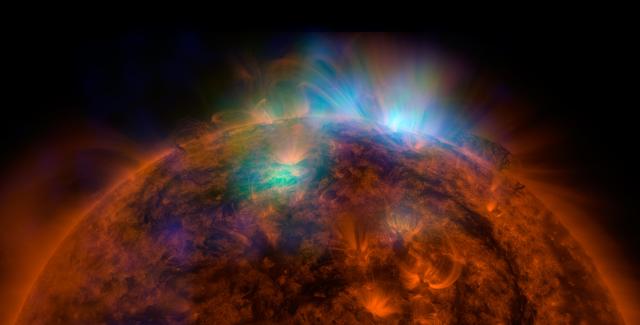
NASA's Solar Dynamics Observatory came across an oddity this week that the spacecraft has rarely observed before: a dark filament encircling an active region on Oct. 29-31, 2017.
Ver en NASA ↗This composite image presents the three most visible elements of space weather: a storm from the Sun, aurora as seen from space, and aurora as seen from the Earth. The solar storm is a corona mass ejection (CME) composite from EIT 304Å superimposed on a LASC…
Ver en NASA ↗This image from NASA Dawn spacecraft shows the sun illuminating the landscape of asteroid Vesta during a Vestan unrise; the sun had a low angle relative to Vesta surface, just as the sun has a low angle in the sky in the morning on Earth.
Ver en NASA ↗STS-36 Earth observation shows sun beaming off ocean waters with heavy cloud cover.
Ver en NASA ↗Expedition 47 Earth observation composite created with iss047e078039 - iss047e078041 137B1653-137B1655 Sun glint 1150 mm lens
Ver en NASA ↗NASA TV video from yesterday's total solar eclipse, when the moon pass directly in front of the sun. It happened from 8:38 to 8:42 p.m. EST March 8. As the moon passed precisely between the sun and Earth – a relatively rare occurrence that happens only about …
Ver en NASA ↗NASA's Solar Dynamics Observatory observed a large coronal hole has been spewing solar wind particles in the general direction of Earth over the past few days (Aug. 31- Sept. 1, 2017).
Ver en NASA ↗This EIT 171 image shows a wide variety of loops and active regions (lighter areas on the surface). Taken on November 9, 1998. The 171 filter shows emission from 8 and 9 times ionized iron at about 1 million degrees C. Credit: NASA/GSFC/SOHO/ESA To learn mo…
Ver en NASA ↗During the total solar eclipse, the Sun’s corona, only visible during the total eclipse, is shown as a crown of white flares from the surface. The red spots called Bailey's beads occurs where the moon grazes by the Sun and the rugged lunar limb topography all…
Ver en NASA ↗During the total solar eclipse, the Sun’s corona, only visible during the total eclipse, is shown as a crown of white flares from the surface. The red spots called Bailey's beads occurs where the moon grazes by the Sun and the rugged lunar limb topography all…
Ver en NASA ↗During the total solar eclipse, the Sun’s corona, only visible during the total eclipse, is shown as a crown of white flares from the surface. The red spots called Bailey's beads occurs where the moon grazes by the Sun and the rugged lunar limb topography all…
Ver en NASA ↗Boyertown Area High School 12th grade student Ben Maurer uses his smartphone and a photographers lens with a solar filter to make a photograph of the planet Mercury transitting the sun, Monday, May 9, 2016, Boyertown area High School, Boyertown, Pennsylvania.…
Ver en NASA ↗Boyertown Area High School students, 12th grader Bransen Mackey, left, and 11th grader Nick Cioppi wear solar safety glasses and attempt to see the planet Mercury as it transits across the face of the sun, Monday, May 9, 2016, Boyertown, Pennsylvania. Mercur…
Ver en NASA ↗Boyertown Area High School astronomy teacher Peter Detterline prepares high powered binoculars with a solar filter so that his students may view the planet Mercury as it transits across the face of the sun , Monday, May 9, 2016, Boyertown Area High School, Bo…
Ver en NASA ↗Boyertown Area High School 12th grade student Jay Hallman looks through a photographers lens and solar filter to see the planet Mercury as it transits across the face of the sun , Monday, May 9, 2016, Boyertown area High School, Boyertown, Pennsylvania. Merc…
Ver en NASA ↗During the total solar eclipse, the Sun’s corona, only visible during the total eclipse, is shown as a crown of white flares from the surface. The red spots called Bailey's beads occurs where the moon grazes by the Sun and the rugged lunar limb topography all…
Ver en NASA ↗In mid-February, before and after MESSENGER latest perihelion closest approach to the Sun, an imaging campaign was conducted to search for vulcanoids, small rocky bodies that have been postulated to exist in orbits between Mercury and the Sun.
Ver en NASA ↗An artist conception of one of NASA Solar Terrestrial Relations Observatory STEREO spacecraft. The two observatories currently lie on either side of the sun, providing views of the entire sun simultaneously.
Ver en NASA ↗Data from NASA Cassini spacecraft have enabled scientists to create this map of the heliosphere, the bubble of charged particles around our sun. Charged particles stream out from our sun in a phenomenon known as solar wind.
Ver en NASA ↗This diagram illustrates the positions of Mars, Earth and the sun during a period that occurs approximately every 26 months, when Mars passes almost directly behind the sun from Earth perspective.
Ver en NASA ↗Kepler-20e is the first planet smaller than the Earth discovered to orbit a star other than the sun. A year on Kepler-20e only lasts 6 days, as it is much closer to its host star than the Earth is to the sun.
Ver en NASA ↗The Solar Dynamics Observatory SDO spacecraft, shown above the Earth as it faces toward the Sun. SDO is designed to study the influence of the Sun on the Earth and the inner solar system by studying the solar atmosphere.
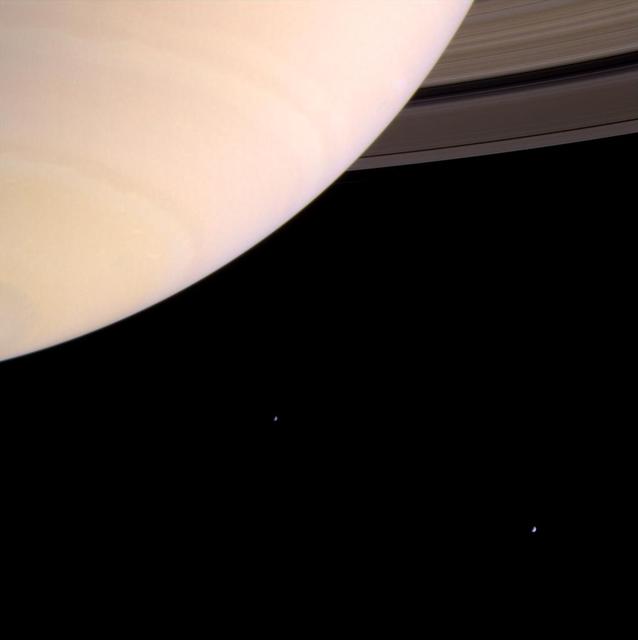
Ver en NASA ↗As ring particles emerge from the darkness of Saturn shadow, they pass through a region of twilight. The Sun light, refracted by the planet atmosphere, peeks around the limb, followed shortly by the Sun itself
Ver en NASA ↗Contenido y metadatos proporcionados por la NASA Image and Video Library.