





/NASA’s%20Artemis%20III%20Announcement%20(Official%20NASA%20Trailer)~thumb.jpg)

S62-04534 (3 Oct. 1962) --- Landing with parachute extended of astronaut Walter M. Schirra's Mercury-Atlas 8 (MA-8) capsule, called the Sigma 7, after a world orbital flight. Photo credit: NASA
Ver en NASA ↗🚀 Biblioteca espacial oficial
Imágenes y vídeos de NASA
Explora el catálogo multimedia público de NASA sin salir de TuPortalNews.
Explora temas destacados
Selecciona un tema o realiza una búsqueda personalizada.
2.907 resultados en NASA
The area on the opposite side of Mercury from the large Caloris impact basin is home to uncommonly bumpy and grooved terrain.
Ver en NASA ↗This is one of the earliest images of Mercury returned by NASA's MESSENGER spacecraft. It was taken in January 2008.
Ver en NASA ↗Out of the Basin. These images from NASA MESSENGER MASCS top and MDIS bottom are of Rembrandt, Mercury second largest impact basin.
Ver en NASA ↗Watchers of the Wall. This image from NASA MESSENGER spacecraft features the sharp rim of an unnamed complex crater on Mercury.
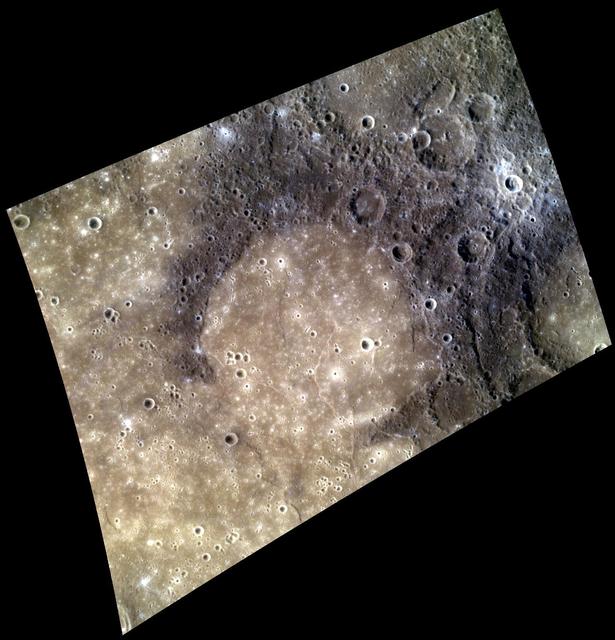
Ver en NASA ↗Raditladi basin, imaged during MESSENGER first Mercury flyby and named in April 2008, is intriguing for several reasons.
Ver en NASA ↗S64-14854 (20 Feb. 1962) --- Astronaut John H. Glenn Jr. and technicians inspect a decal ready for application to the side of his Mercury spacecraft prior to launch on Feb. 20, 1962. The decal reads "Friendship 7". Photo credit: NASA
Ver en NASA ↗S64-36910 (February 1962) --- Astronaut John H. Glenn Jr., wearing a Mercury pressure suit, was the pilot of the Mercury-Atlas 6 (MA-6) mission. Glenn made America's first manned Earth-orbiting spaceflight on Feb. 20, 1962. This photograph was taken at Cape …
Ver en NASA ↗A hot jet research facility, used extensively in the design and development of the reentry heat shield on the Project Mercury spacecraft. The electrically-heated arc jet simulates the friction heating encountered by a space vehicle as it returns to the earth'…
Ver en NASA ↗The group portrait of the original seven astronauts for the Mercury Project. NASA selected its first seven astronauts on April 27, 1959. Left to right at front: Walter M. Wally Schirra, Donald K. Deke Slayton, John H. Glenn, Jr., and Scott Carpenter. Left to …
Ver en NASA ↗Technicians attach the escape tower to the Mercury capsule prior to assembly with Little Joe launcher, August 20, 1959. Joseph Shortal describe this as follows (vol. 3., p. 33): The escape tower and rocket motors were taken from the Mercury capsule productio…
Ver en NASA ↗Technicians attach the escape tower to the Mercury capsule prior to assembly with Little Joe launcher, August 20, 1959. Joseph Shortal describe this as follows (vol. 3., p. 33): The escape tower and rocket motors were taken from the Mercury capsule productio…
Ver en NASA ↗Technicians attach the escape tower to the Mercury capsule prior to assembly with Little Joe launcher, August 20, 1959. Joseph Shortal describe this as follows (vol. 3., p. 33): The escape tower and rocket motors were taken from the Mercury capsule productio…
Ver en NASA ↗The Mercury capsule and escape tower are being lowered onto the Little Joe booster for launch on August 21, 1959. Joseph Shortal described this as follows (vol. 3, p. 33): The Little Joe booster was assembled at Wallops on its special launcher in a vertical …
Ver en NASA ↗The Mercury capsule and escape tower are being lowered onto the Little Joe booster for launch on August 21, 1959. Joseph Shortal described this as follows (vol. 3, p. 33): The Little Joe booster was assembled at Wallops on its special launcher in a vertical …
Ver en NASA ↗In this perspective view, NASA MESSENGER spacecraft looked northwest over the Caloris Basin, a depression about 1500 km in diameter formed several billion years ago by the impact of a large projectile into the surface of Mercury.
Ver en NASA ↗S62-01358 (1962) --- Project Mercury astronaut M. Scott Carpenter, prime pilot of the Mercury-Atlas 7 (MA-7) spaceflight, goes through a water egress test. He is in the Mercury pressure suit, without the helmet, and is wearing a life vest. Photo credit: NASA
Ver en NASA ↗The image of the Moon left is a mosaic of images from NASA Clementine. The Mercury image right is a NASA Mariner 10 mosaic.
Ver en NASA ↗This crater illustrates the narrow hummocky rim facies, radial ridges, and surrounding extensive field of secondary craters. This image of Mercury was taken by NASA Mariner 10.
Ver en NASA ↗A fresh new crater in the center of an older crater basin is shown in this picture of the surface of Mercury taken March 29, 1974 by NASA Mariner 10.
Ver en NASA ↗Small graben, narrow linear troughs, have been found associated with small scarps (bottom left, white arrows) on Mercury and the Moon are seen here by NASA's MESSENGER spacecraft.
Ver en NASA ↗Impact craters and basins on Mercury are named for deceased artists, musicians, painters, and authors who have made outstanding contributions to their fields in this image taken by NASA MESSENGER.
Ver en NASA ↗NASA MESSENGER high-resolution images obtained during the mission second Mercury flyby have revealed a number of irregularly shaped depressions on the floor of Praxiteles crater.
Ver en NASA ↗On January 14, 2008, NASA MESSENGER became the first spacecraft to see the side of Mercury shown in this image -- the historic first look at the previously unseen side.
Ver en NASA ↗Contenido y metadatos proporcionados por la NASA Image and Video Library.