




/NASA’s%20Artemis%20III%20Announcement%20(Official%20NASA%20Trailer)~thumb.jpg)

Saturn B-ring
Ver en NASA ↗🚀 Biblioteca espacial oficial
Imágenes y vídeos de NASA
Explora el catálogo multimedia público de NASA sin salir de TuPortalNews.
Explora temas destacados
Selecciona un tema o realiza una búsqueda personalizada.
4.237 resultados en NASA
Saturn Ring Rhythm
Ver en NASA ↗Saturn Watch Spiral
Ver en NASA ↗Saturn B and C-rings
Ver en NASA ↗The flame and exhaust from the test firing of an F-1 engine blast out from the Saturn S-IB Static Test Stand in the east test area of the Marshall Space Flight Center. A Cluster of five F-1 engines, located in the S-IC (first) stage of the Saturn V vehicle, p…
Ver en NASA ↗Pictured is the Saturn V S-IC-T stage (static testing stage) being assembled in the horizontal assembly station at the Marshall Space Flight Center (MSFC), building 4705. This stage underwent numerous static firings at the newly-built S-IC Static Test Stand a…
Ver en NASA ↗Saturn's active, ocean-bearing moon Enceladus sinks behind the giant planet in a farewell portrait from NASA's Cassini spacecraft. This view of Enceladus was taken by the Cassini spacecraft on Sept. 13, 2017.
Ver en NASA ↗Janus is spotted over Saturn north pole in this image while Mimas shadow glides across Saturn in this image from NASA Cassini spacecraft. Janus is the faint dot that appears just above Saturn north pole.
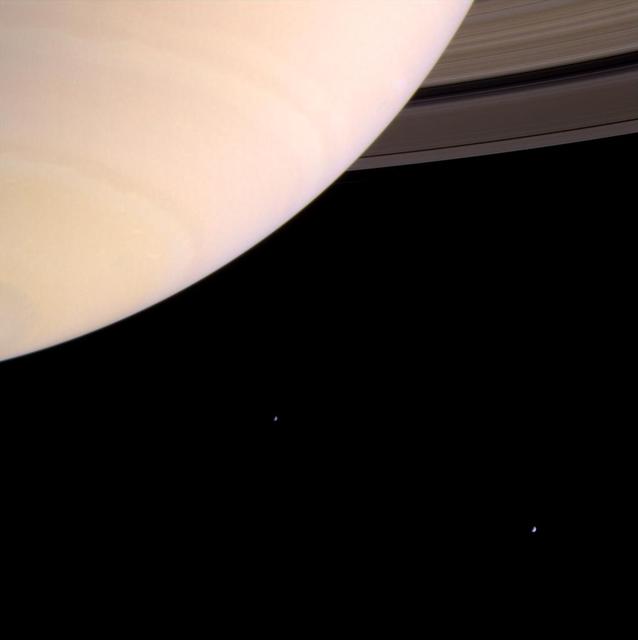
Ver en NASA ↗Saturn moon Mimas appears near Saturn, dwarfed by its parent planet in this image. Mimas appears tiny compared to the storms clearly visible in far northern and southern hemispheres of Saturn.
Ver en NASA ↗A spider beam for cornecting the Saturn I fuel tanks is being positioned in the fabrication and engineering laboratory of the Marshall Space Flight Center (MSFC).
Ver en NASA ↗The Saturn IB S-IVB (second) stages in storage at the Douglas Aircraft Company's Sacramento Test Operations Facility (SACTO) in Sacramento, California. Designed and developed by the Marshall Space Flight Center and the Douglas Aircraft Company, the S-IVB stag…
Ver en NASA ↗This cutaway of the Saturn I S-IV stage (second stage) illustrates the booster's components. Powered by six RL-10 engines, the S-IV stage was capable of producing 90,000 pounds of thrust. Development of the Saturn S-IV stage by the Marshall Space Flight Cente…
Ver en NASA ↗The photograph shows the completed Saturn 1 S-1 stage (booster) during the checkout in the Marshall Space Flight Center, building 4705, January 23, 1961. The Saturn I S-I stage had eight H-1 engines clustered, using liquid oxygen/kerosene-1 (LOX/RP-1) propell…
Ver en NASA ↗The Marshall Space Flight Center's first Saturn I vehicle, SA-1, lifts off from Cape Canaveral, Florida, on October 27, 1961. This early configuration, Saturn I Block I, 162 feet tall and weighing 460 tons, consisted of the eight H-1 engines S-I stage and the…
Ver en NASA ↗The S-I stages for the Saturn I (SA-1 at right and SA-2 at left) are being assembled at the Marshall Space Flight Center, building 4705. The Saturn I S-I stage had eight H-1 engines clustered, using liquid oxygen/kerosene-1 (LOX/RP-1) propellants capable of p…
Ver en NASA ↗The Saturn Project was approved on January 18, 1960 as a program of the highest national priority. The formal test program to prove out the clustered-booster concept was well underway at Redstone Arsenal. This photograph depicts a mockup of the Saturn booster…
Ver en NASA ↗Progress in the Saturn program, depicted below, was described by Dr. Wernher von Braun, Marshall Space Flight Center (MSFC) Director, in an appearance before the Senate Committee of Aeronautical and Space Sciences. "The flight configuration of the giant three…
Ver en NASA ↗In this image from NASA Cassini spacecraft, the gravitational pull of Saturn moon Prometheus creates patterns in Saturn F ring.
Ver en NASA ↗Three of Saturn moons are captured with the planet in this exquisite family portrait. At top, Saturn is bedecked with the shadows of its innermost rings
Ver en NASA ↗The launch of the SA-7 (Saturn I Block II) was on September 18, 1964. The SA-7 mission was the second orbital flight of the S-IV stage (second stage) with the payload consisting of the Apollo command and service module's instrument unit. The Saturn I Block II…
Ver en NASA ↗A cluster of eight H-1 engines were used to thrust the first stage of Saturn I (S-I stage) and Saturn IB (S-IB stage). The engines were arranged in a double pattern. Four engines, located inboard, were fixed in a square pattern around the stage axis, while th…
Ver en NASA ↗The Apollo 11 mission, the first manned lunar mission, launched from the Kennedy Space Center, Florida via the Saturn V launch vehicle on July 16, 1969 and safely returned to Earth on July 24, 1969. The Saturn V vehicle produced a holocaust of flames as it r…
Ver en NASA ↗This photograph is a view of stacking the major components of the S-IC (first) stage of the Saturn V vehicle at the Boeing vertical assembly building at the Michoud Assembly Facility (MAF). The view shows the Saturn V S-IC (first) stage thrust structure being…
Ver en NASA ↗A close-up view of the F-1 Engine for the Saturn V S-IC (first) stage depicts the complexity of the engine. Developed by Rocketdyne under the direction of the Marshall Space Flight Center, the F-1 engine was utilized in a cluster of five engines to propel the…
Ver en NASA ↗Contenido y metadatos proporcionados por la NASA Image and Video Library.