





/NASA’s%20Artemis%20III%20Announcement%20(Official%20NASA%20Trailer)~thumb.jpg)

CAPE CANAVERAL, Fla. – Former NASA astronaut Tom Jones, left, presses the button on a simulated model of an asteroid to mark the grand opening of the new Great Balls of Fire exhibit at NASA’s Kennedy Space Center Visitor Complex in Florida. To his right is Th…
Ver en NASA ↗🚀 Biblioteca espacial oficial
Imágenes y vídeos de NASA
Explora el catálogo multimedia público de NASA sin salir de TuPortalNews.
Explora temas destacados
Selecciona un tema o realiza una búsqueda personalizada.
1.036 resultados en NASA
CAPE CANAVERAL, Fla. – The grand opening of the new Great Balls of Fire exhibit was held at NASA’s Kennedy Space Center Visitor Complex in Florida. The grand opening featured remarks by former NASA astronaut Tom Jones, and Therrin Protze, chief operating offi…
Ver en NASA ↗CAPE CANAVERAL, Fla. – Former NASA astronaut Tom Jones, left, joins Andrea Farmer, senior public relations manager, and Therrin Protze, chief operating officer, both with Delaware North Parks and Resorts at NASA's Kennedy Space Center Visitor Complex in Flori…
Ver en NASA ↗CAPE CANAVERAL, Fla. – Therrin Protze, chief operating officer with Delaware North Parks and Resorts at NASA's Kennedy Space Center Visitor Complex in Florida, welcomes guests to the grand opening of the Great Balls of Fire exhibit. Great Balls of Fire sha…
Ver en NASA ↗CAPE CANAVERAL, Fla. – Lights flickered and balloons fell as former NASA astronaut Tom Jones, left, and Therrin Protze, chief operating officer of Delaware North Parks and Resorts at NASA’s Kennedy Space Center Visitor Complex in Florida, welcomed guests to t…
Ver en NASA ↗CAPE CANAVERAL, Fla. – A real asteroid is on display at the new Great Balls of Fire exhibit at NASA’s Kennedy Space Center Visitor Complex in Florida. The grand opening of the new attraction featured remarks by former NASA astronaut Tom Jones, and Therrin Pro…
Ver en NASA ↗S74-20010 (November-December 1973) --- Six frames of Skylab 4 Far Ultraviolet Electronographic (S201 experiment) photograph showing halo of Comet Kohoutek. Photo credit: NASA
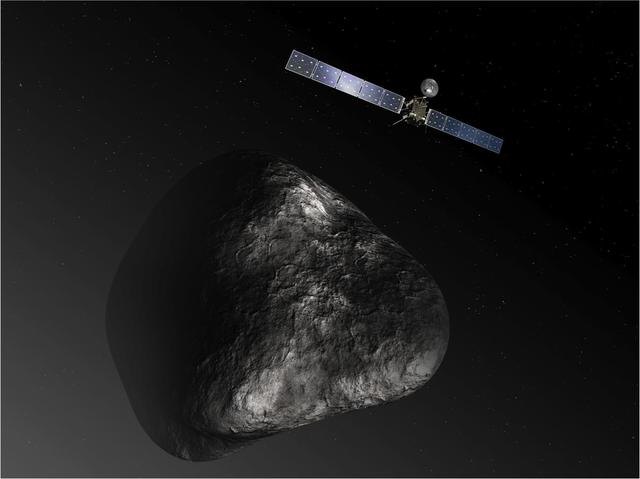
Ver en NASA ↗This is an artist conception of a solar-system montage of the eight planets, a comet and an asteroid.
Ver en NASA ↗This image shows the view from NASA Deep Impact flyby spacecraft as it turned back to look at comet Tempel 1. Fifty minutes earlier, the spacecraft probe was run over by the comet.
Ver en NASA ↗This image of the surface of comet Tempel 1 was taken about 20 seconds before NASA Deep Impact probe crashed into the comet on July 3, 2005. This particular region contains the impact site.
Ver en NASA ↗This false-color image shows comet Tempel 1 as seen by NASA Chandra X-ray Observatory on June 30, 2005, Universal Time. The comet was bright and condensed.
Ver en NASA ↗New measurements from NASA Herschel Space Observatory have discovered water with the same chemical signature as our oceans in a comet called Hartley 2 pictured at right. The image at bottom right is an artist concept of a comet.
Ver en NASA ↗Taken on April 25, 2005, sixty-nine days before it gets up-close-and-personal with a comet, NASA Deep Impact spacecraft successfully photographed its quarry, comet Tempel 1, at a distance of 39.7 million miles.
Ver en NASA ↗NASA EPOXI mission spacecraft obtained these views of the icy particle cloud around comet Hartley 2. The image on the left is the full image of comet Hartley 2 for context, and the image on the right was enlarged and cropped.
Ver en NASA ↗This image shows the view from NASA Deep Impact probe 30 minutes before it was pummeled by comet Tempel 1. The picture brightness has been enhanced to show the jets of dust streaming away from the comet.
Ver en NASA ↗This image shows the tracks left by two comet particles after they impacted NASA Stardust spacecraft comet dust collector. The collector is made up of a low-density glass material called aerogel.
Ver en NASA ↗STS083-410-009 (4-8 April 1997) --- A 35mm camera was used to record this time-exposed image of Comet Hale-Bopp at sunset. Note that stars show up in this image because of the more lengthy exposure time, whereas the celestial features do not show in the majo…
Ver en NASA ↗STS083-410-008 (4-8 April 1997) --- A 35mm camera was used to record this time-exposed image of Comet Hale-Bopp at sunset. Note that stars show up in this image because of the more lengthy exposure time, whereas the celestial features do not show in the majo…
Ver en NASA ↗STS083-410-011 (4-8 April 1997) --- A 35mm camera was used to record this time-exposed image of Comet Hale-Bopp at sunset. Note that stars show up in this image because of the more lengthy exposure time, whereas the celestial features do not show in the major…
Ver en NASA ↗728L9485.NEF
Ver en NASA ↗694N4283.NEF
Ver en NASA ↗728T7442.NEF
Ver en NASA ↗728L8536.NEF
Ver en NASA ↗728A8058.NEF
Ver en NASA ↗Contenido y metadatos proporcionados por la NASA Image and Video Library.