





/NASA’s%20Artemis%20III%20Announcement%20(Official%20NASA%20Trailer)~thumb.jpg)

S61-02821 (21 July 1961) --- Attempted recovery of Mercury spacecraft at end of the Mercury-Redstone 4 (MR-4) mission. View shows the Marine helicopter dropping a recovery line to the capsule. In the upper left corner of the view, the recovery ship and anothe…
Ver en NASA ↗🚀 Biblioteca espacial oficial
Imágenes y vídeos de NASA
Explora el catálogo multimedia público de NASA sin salir de TuPortalNews.
Explora temas destacados
Selecciona un tema o realiza una búsqueda personalizada.
2.907 resultados en NASA
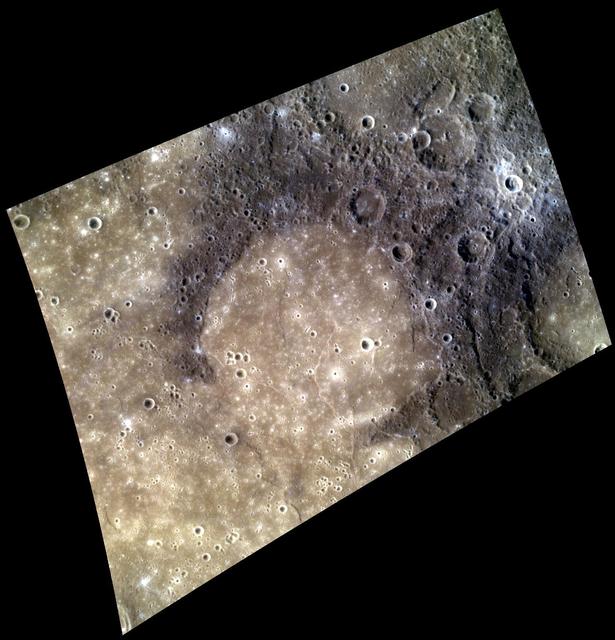
This colorful view of Mercury was produced by using images from the color base map imaging campaign during MESSENGER's primary mission. These colors are not what Mercury would look like to the human eye, but rather the colors enhance the chemical, mineralogic…
Ver en NASA ↗S64-40111 (1964) --- Wide angle view of the Mercury 7 memorial dedication. Photo credit: NASA
Ver en NASA ↗NASA's Perseverance Mars rover used its Mastcam-Z camera to capture Mercury – seen as a tiny speck – passing in front of the Sun on Oct. 28, 2023.
Ver en NASA ↗It looks like even the craters on Mercury have heard of Bob Ross! The central peaks of this complex crater have formed in such a way that it resembles a smiling face. This image is oriented so north is toward the bottom. This image was acquired as a high-res…
Ver en NASA ↗Date acquired: May 05, 2014 Today's color image features both Mercury's terminator and limb. The terminator is the striking separation of night and day on Mercury. It is seen in this image with the change from dark, on the left of the image, to light. Mercur…
Ver en NASA ↗These images were taken every five minutes by MESSENGER as the spacecraft departed Mercury after completing its second flyby on October 6, 2008. A portion of the same sequence, totaling 198 images in all, has also been made into a movie.
Ver en NASA ↗Just 21 minutes after NASA MESSENGER spacecraft closest approach to Mercury, the Narrow Angle Camera NAC took this picture showing a variety of intriguing surface features, including craters as small as about 400 meters about 400 yards across.
Ver en NASA ↗Five previously unnamed craters on Mercury now have names. Shown here are Carolan, Enheduanna, Karsh, Kulthum, and Rivera as seen by NASA MESSENGER spacecraft.
Ver en NASA ↗This colorful view of Mercury was produced by using images from the color base map imaging campaign during MESSENGER's primary mission. These colors are not what Mercury would look like to the human eye, but rather the colors enhance the chemical, mineralogic…
Ver en NASA ↗Astronaut John Glenn enters the Mercury spacecraft, Friendship 7, prior to the launch of MA-6 on February 20, 1961 and became the first American who orbited the Earth. The MA-6 mission was the first manned orbital flight boosted by the Mercury-Atlas vehicle, …
Ver en NASA ↗Astronaut John Glenn enters the Mercury spacecraft, Friendship 7, prior to the launch of MA-6 on February 20, 1961 and became the first American who orbited the Earth. The MA-6 mission was the first manned orbital flight boosted by the Mercury-Atlas vehicle, …
Ver en NASA ↗The recovery operation of the Faith 7 spacecraft after the completion of the 1-1/2 day orbital flight (MA-9 mission) with Astronaut Gordon Cooper. Navy frogmen attach the flotation collar to the spacecraft. The MA-9 mission was the last flight of the Mercury …
Ver en NASA ↗This spectacular color mosaic shows the eastern limb of Mercury as seen by NASA MESSENGER as the spacecraft departed the planet following the mission first Mercury flyby in January 2008.
Ver en NASA ↗NASA image acquired: March 29, 2011 MESSENGER acquired this image of Mercury's horizon as the spacecraft was moving northward along the first orbit during which MDIS was turned on. Bright rays from Hokusai can be seen running north to south in the image. MDI…
Ver en NASA ↗Astronaut Virgil I. "Gus" Grissom, one of the original seven astronauts for Mercury Project selected by NASA on April 27, 1959. The MR-4 mission, boosted by the Mercury-Redstone vehicle, made the second marned suborbital flight. The capsule, Liberty Bell 7, s…
Ver en NASA ↗Scale model of Mercury capsule shape A, indicating the position of the astronaut.
Ver en NASA ↗Scale model of Mercury capsule shape A, indicating the position of the astronaut.
Ver en NASA ↗Scale model of Mercury capsule shape A, indicating the position of the astronaut.
Ver en NASA ↗The planet Mercury is seen in silhouette, lower left of image, as it transits across the face of the sun, Monday, May 9, 2016, as viewed from Boyertown, Pennsylvania. Mercury passes between Earth and the sun only about 13 times a century, with the previous t…
Ver en NASA ↗The planet Mercury is seen in silhouette, lower center of image, as it transits across the face of the sun, Monday, May 9, 2016, as viewed from Boyertown, Pennsylvania. Mercury passes between Earth and the sun only about 13 times a century, with the previous…
Ver en NASA ↗The planet Mercury is seen in silhouette, lower third of image, as it transits across the face of the sun Monday, May 9, 2016, as viewed from Boyertown, Pennsylvania. Mercury passes between Earth and the sun only about 13 times a century, with the previous t…
Ver en NASA ↗The planet Mercury is seen in silhouette, lower left, as it transits across the face of the sun Monday, May 9, 2016, as viewed from Boyertown, Pennsylvania. Mercury passes between Earth and the sun only about 13 times a century, with the previous transit tak…
Ver en NASA ↗The planet Mercury is seen in silhouette, lower left of image, as it transits across the face of the sun, Monday, May 9, 2016, as viewed from Boyertown, Pennsylvania. Mercury passes between Earth and the sun only about 13 times a century, with the previous t…
Ver en NASA ↗Contenido y metadatos proporcionados por la NASA Image and Video Library.