





/NASA’s%20Artemis%20III%20Announcement%20(Official%20NASA%20Trailer)~thumb.jpg)

Sparked by a medium-sized C-class flare, a long, magnetic filament burst out from the Sun, producing one of the best shows that SDO has seen Aug. 31, 2012.
Ver en NASA ↗🚀 Biblioteca espacial oficial
Imágenes y vídeos de NASA
Explora el catálogo multimedia público de NASA sin salir de TuPortalNews.
Explora temas destacados
Selecciona un tema o realiza una búsqueda personalizada.
6.531 resultados en NASA
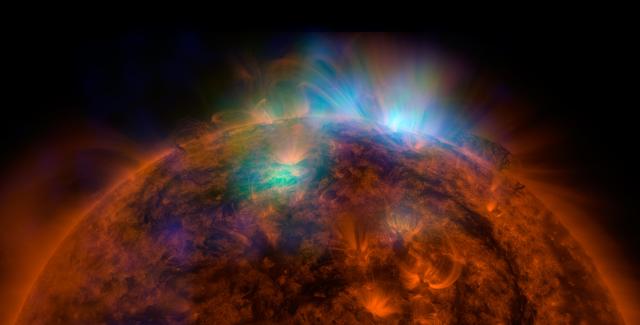
NASA's Solar Dynamics Observatory shows an active region that appeared on Dec. 5, 2018.
Ver en NASA ↗Sunspots are seen in images captured by NASA's Perseverance Mars rover using its Mastcam-Z cameras between May 8 and 20, 2024. These flares would send charged particles toward Mars, where several NASA spacecraft were able to study them.
Ver en NASA ↗On Sept. 10, 2017, NASA's Solar Dynamics Observatory, observed the Sun erupting with an X8 solar flare, one of the largest of the current solar cycle.
Ver en NASA ↗With no active regions currently on the face of the sun, NASA's Solar Dynamics Observatory observed a bristling active region showing numerous arches of bright, magnetic field lines blossoming out and towering above it beginning to rotate into view.
Ver en NASA ↗NASA's Solar Dynamics Observatory sees several short stalks of cooler, darker plasma spun and twisted as they interacted with each other at the sun's edge, June 14-15, 2017.
Ver en NASA ↗Illustration of a CME particle cloud blasted from the sun impacting Earth and creating aurora (in actual photo of aurora as taken by an astronaut on the space station). Credit: NASA/GSFC/SOHO/ESA To learn more go to the SOHO website: sohowww.nascom.nasa.go…
Ver en NASA ↗The last glimmer of the sun is seen as the moon makes its final move over the sun during the total solar eclipse on Monday, August 21, 2017 above Madras, Oregon. A total solar eclipse swept across a narrow portion of the contiguous United States from Lincoln …
Ver en NASA ↗The Sun blew out a coronal mass ejection along with part of a solar filament over a three-hour period (Feb. 24, 2015). While some of the strands fell back into the Sun, a substantial part raced into space in a bright cloud of particles (as observed by the SOH…
Ver en NASA ↗NASA's Solar Dynamics Observatory captured this image of a mid-level solar flare – as seen in the bright flash in the middle –on Dec. 16, 2014 shortly before midnight EST. Read more: 1.usa.gov/1BYLxsE Image Credit: NASA/Goddard/SDO NASA image use policy. …
Ver en NASA ↗NASA's Solar Dynamics Observatory captured this image of a mid-level solar flare – as seen in the bright flash in the middle –on Dec. 16, 2014 shortly before midnight EST. Read more: 1.usa.gov/1BYLxsE Image Credit: NASA/Goddard/SDO NASA image use policy. …
Ver en NASA ↗The planet Mercury is seen in silhouette as it nearly completes transiting across the face of the Sun, Monday, Nov. 11, 2019, in Arlington, Virginia. Mercury’s last transit was in 2016. the next won't happen again until 2032. Photo Credit: (NASA/Bill Ingalls)
Ver en NASA ↗The planet Mercury is seen in silhouette, low center, as it transits across the face of the Sun Monday, Nov. 11, 2019, from Washington. Mercury’s last transit was in 2016. The next won’t happen again until 2032. Photo Credit: (NASA/Bill Ingalls)
Ver en NASA ↗The planet Mercury is seen in silhouette as it nearly completes transiting across the face of the Sun, Monday, Nov. 11, 2019, in Arlington, Virginia. Mercury’s last transit was in 2016. the next won't happen again until 2032. Photo Credit: (NASA/Bill Ingalls)
Ver en NASA ↗The planet Mercury is seen in silhouette, center, as it transits across the face of the Sun Monday, Nov. 11, 2019, from Washington. Mercury’s last transit was in 2016. The next won’t happen again until 2032. Photo Credit: (NASA/Bill Ingalls)
Ver en NASA ↗The Sun blew out a coronal mass ejection along with part of a solar filament over a three-hour period (Feb. 24, 2015). While some of the strands fell back into the Sun, a substantial part raced into space in a bright cloud of particles (as observed by the SOH…
Ver en NASA ↗This still image from an animation from NASA GSFC Solar Dynamics Observatory shows magnetically charged particles forming a nicely symmetrical arch at the edge of the Sun as they followed the magnetic field lines of an active region Aug.4-5, 2015.
Ver en NASA ↗The Apollo Telescope Mount (ATM) was designed and developed by the Marshall Space Flight Center and served as the primary scientific instrument unit aboard Skylab (1973-1979). The ATM contained eight complex astronomical instruments designed to observe the Su…
Ver en NASA ↗Noctilucent clouds, high-altutude clouds visible during the summer months and illuminated when the sun is below Earth's horizon, are pictured from the International Space Station as it orbited 259 miles above the Pacific Ocean south of Alaska.
Ver en NASA ↗Using the Solar Vector Magnetograph, a solar observation facility at NASA's Marshall Space Flight Center (MSFC), scientists from the National Space Science and Technology Center (NSSTC) in Huntsville, Alabama, are monitoring the explosive potential of magneti…
Ver en NASA ↗Using the Solar Vector Magnetograph, a solar observation facility at NASA's Marshall Space Flight Center (MSFC), scientists from the National Space Science and Technology Center (NSSTC) in Huntsville, Alabama, are monitoring the explosive potential of magneti…
Ver en NASA ↗A stream of plasma burst out from the sun, but since it lacked enough force to break away, most of it fell back into the sun (May 27, 2014). This eruption was minor and such events occur almost every day on the sun and suggest the kind of dynamic activity be…
Ver en NASA ↗This single frame from a sequence of six images of an animation shows sunspots as viewed by NASA Curiosity Mars rover from April 4 to April 15, 2015. From Mars, the rover was in position to see the opposite side of the sun.
Ver en NASA ↗S73-26127 (1973) --- An artist's concept of the Skylab space station cluster in Earth orbit illustrating the deployment of the twin pole thermal shield to shade the Orbital Workshop (OWS) from the sun. This is one of the sunshade possibilities considered to s…
Ver en NASA ↗Contenido y metadatos proporcionados por la NASA Image and Video Library.