





/NASA’s%20Artemis%20III%20Announcement%20(Official%20NASA%20Trailer)~thumb.jpg)

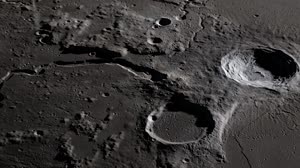
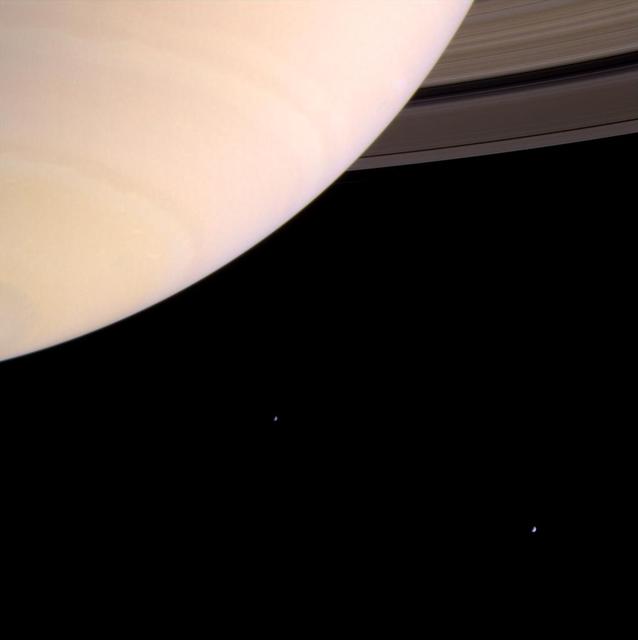
In this image from NASA Cassini spacecraft, two large craters on Tethys, near the line where day fades to night, almost resemble two giant eyes observing Saturn. Tethys is significantly closer to the camera, while the planet is in the background.
Ver en NASA ↗🚀 Biblioteca espacial oficial
Imágenes y vídeos de NASA
Explora el catálogo multimedia público de NASA sin salir de TuPortalNews.
Explora temas destacados
Selecciona un tema o realiza una búsqueda personalizada.
4.237 resultados en NASA
These natural color views from NASA's Cassini spacecraft compare the appearance of Saturn's north-polar region in June 2013 and April 2017.
Ver en NASA ↗This 1967 illustration compares the Apollo Saturn V Spacecraft of the Moon Landing era to the Statue of Liberty located on Liberty Island in New York City. The Apollo Saturn V, at 363 feet towers above Lady Liberty, as the statue is called, standing at 305 fe…
Ver en NASA ↗Pictured is one of the earliest testing of the Saturn I S-I (first) stage, with a cluster of eight H-1 engines, at the Marshall Space Flight Center (MSFC). It was a part of the test program to prove out the clustered-booster concept. MSFC was responsible for …
Ver en NASA ↗J-2 engines for the Saturn IB/Saturn V launch vehicles are lined up in the assembly area at Rocketdyne's manufacturing plant in Canoga Park, California. Five J-2 engines provided more than 1,000,000 pounds of thrust to accelerate the second stage toward a Moo…
Ver en NASA ↗This false-color infrared image, obtained by NASA Cassini spacecraft, shows clouds of large ammonia ice particles dredged up by a powerful storm in Saturn northern hemisphere.
Ver en NASA ↗This image from NASA Cassini, made possible only as Saturn north pole emerged from winter darkness, shows new details of a jet stream that follows a hexagon-shaped path and has long puzzled scientists.
Ver en NASA ↗This photo shows the closeout welding operation of the liquid oxygen (LOX) tank for the Saturn V SA-501 vehicle for the Apollo 4 mission.
Ver en NASA ↗This illustration shows the major components of the instrument unit (IU). Developed and manufactured by International Business Machines, the IU is 3 feet high and 21 feet in diameter and mounted atop an S-IVB, between the third stage and the Apollo spacecraft…
Ver en NASA ↗The completely assembled Saturn 1 S-1 stage is being ready for checkout in the Marshall Space Flight Center, building 4705, January 18, 1961. The Saturn I S-I stage had eight H-1 engines clustered, using liquid oxygen/kerosene-1 (LOX/RP-1) propellants capable…
Ver en NASA ↗This chart is an illustration of J-2 Engine characteristics. A cluster of five J-2 engines powered the Saturn V S-II (second) stage with each engine providing a thrust of 200,000 pounds. A single J-2 engine powered the S-IVB stage, the Saturn IB second stage,…
Ver en NASA ↗S-IB-200D, a dynamic test version of the Saturn IB launch vehicle's first stage (S-IB), makes its way to the Marshall Space Flight Center (MSFC) East Test Area on January 4, 1965. Test Laboratory persornel assembled a complete Saturn IB to test the structural…
Ver en NASA ↗Workers at the Marshall Space Flight Center's (MSFC) Dynamic Test Stand install S-IB-200D, a dynamic test version of the Saturn IB launch vehicle's first stage, on January 11, 1965. MSFC Test Laboratory persornel assembled a complete Saturn IB to test the lau…
Ver en NASA ↗NASA's Cassini narrow angle camera took this image of Saturn on Feb. 16, 2004, from a distance of 66.1 million kilometers (41.1 million miles) in a special filter which reveals clouds and haze high in the atmosphere.
Ver en NASA ↗S-IVB-505 and S-IVB-211, the flight version of the S-IVB stages, in the McDornell Douglas' S-IVB Assembly and Checkout Tower in Huntington Beach, California. As a part of the Marshall Space Flight Center `s "building block" approach to the Saturn vehicle deve…
Ver en NASA ↗This cutaway drawing shows the S-IVB (third stage) of the Saturn V launch vehicle. As a part of the Marshall Space Flight Center’s (MSFC) “building block” approach to the Saturn development, the S-IVB stage was utilized in the Saturn IB launch vehicle as a s…
Ver en NASA ↗This nighttime view of Saturn north pole reveals a dynamic, active planet at least 75 kilometers 47 miles below the normal cloud tops seen in visible light. Clearly revealed is the bizarre six-sided hexagon feature present at the north pole
Ver en NASA ↗This mosaic combines views captured by NASA's Cassini spacecraft as it made the first dive of the mission's Grand Finale on April 26, 2017, and shows details in bands and swirls in the atmosphere.
Ver en NASA ↗The Apollo 11 mission, the first manned lunar mission, launched from the Kennedy Space Center, Florida via the Saturn V launch vehicle on July 16, 1969 and safely returned to Earth on July 24, 1969. Leaving a wide plume of flame as it climbed into the thin at…
Ver en NASA ↗The Apollo 11 mission, the first manned lunar mission, launched from the Kennedy Space Center, Florida via the Saturn V launch vehicle on July 16, 1969 and safely returned to Earth on July 24, 1969. The Saturn V vehicle produced a holocaust of flames as it ro…
Ver en NASA ↗A view of Saturn clouds extending from 40` to 60` N latitude shows a ribbon-like wave structure in the south with small convective features marking a westward jet in the north. This image was obtained on November 10, 1980 by NASA Voyager 1.
Ver en NASA ↗This false color picture of Saturn’s northern hemisphere was assembled from ultraviolet, violet and green images obtained Aug. 19, 1998 by NASA's Voyager 2. The several weather patterns evident include three spots flowing westward.
Ver en NASA ↗Pictured is a dual position Saturn I/IB test at the T-Stand at Marshall Space Flight Center. This stand was built to test two articles at the same time, thus providing engineers at MSFC with the opportunity to compare identical burns.
Ver en NASA ↗This photograph shows a Saturn V first stage (S-1C). This stage was assembled at the Manufacturing Engineering Laboratory at NASA's Marshall Space Flight Center. With assistance by the Boeing Company, the manufacturer, this first stage was assembled using com…
Ver en NASA ↗Contenido y metadatos proporcionados por la NASA Image and Video Library.