





/NASA’s%20Artemis%20III%20Announcement%20(Official%20NASA%20Trailer)~thumb.jpg)

The planet Mercury is seen in silhouette, low center, as it transits across the face of the Sun Monday, Nov. 11, 2019, from Washington. Mercury’s last transit was in 2016. The next won’t happen again until 2032. Photo Credit: (NASA/Bill Ingalls)
Ver en NASA ↗🚀 Biblioteca espacial oficial
Imágenes y vídeos de NASA
Explora el catálogo multimedia público de NASA sin salir de TuPortalNews.
Explora temas destacados
Selecciona un tema o realiza una búsqueda personalizada.
2.907 resultados en NASA
The planet Mercury is seen in silhouette as it nearly completes transiting across the face of the Sun, Monday, Nov. 11, 2019, in Arlington, Virginia. Mercury’s last transit was in 2016. the next won't happen again until 2032. Photo Credit: (NASA/Bill Ingalls)
Ver en NASA ↗The planet Mercury is seen in silhouette, center, as it transits across the face of the Sun Monday, Nov. 11, 2019, from Washington. Mercury’s last transit was in 2016. The next won’t happen again until 2032. Photo Credit: (NASA/Bill Ingalls)
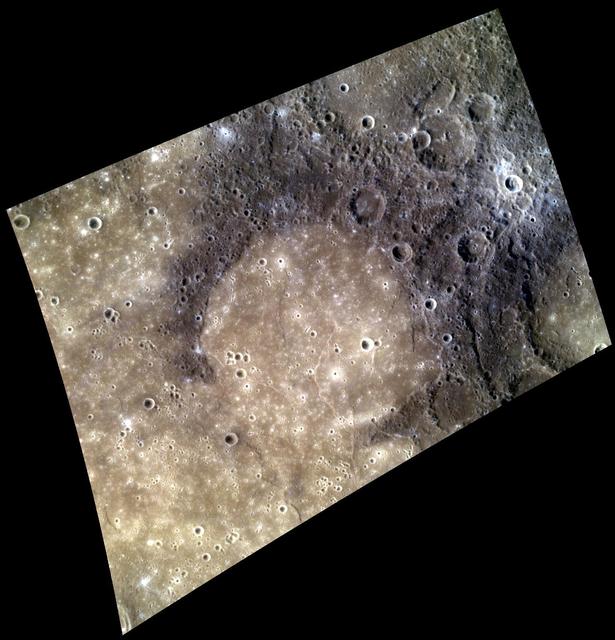
Ver en NASA ↗To put the size of Mercury Rembrandt basin into a familiar context, a NAC mosaic of the basin is overlaid on an AVHRR image of the east coast of the United States
Ver en NASA ↗Model of Mercury being tested in the Unitary Plan Wind Tunnel.
Ver en NASA ↗On January 14, 2008, at 19:04:39 UTC 2:04:39 pm EST, NASA MESSENGER spacecraft experienced its closest approach to Mercury, passing just 200 kilometers 124 miles above the planet surface.
Ver en NASA ↗Measurements from NASA MESSENGER MLA instrument during the spacecraft greater than four-year orbital mission have mapped the topography of Mercury northern hemisphere in great detail.
Ver en NASA ↗The Little Joe launch vehicle for the LJ1 mission on the launch pad at the wallops Flight Facility, Wallops Island, Virginia, on January 21, 1960. This mission achieved the suborbital Mercury cupsule test, testing of the escape system, and biomedical tests by…
Ver en NASA ↗The launch of the Little Joe booster for the LJ1B mission on the launch pad from the wallops Flight Facility, Wallops Island, Virginia, on January 21, 1960. This mission achieved the suborbital Mercury capsule test, testing of the escape system, and biomedica…
Ver en NASA ↗After passing Mercury the first time and making a trip around the Sun, NASA Mariner 10 again flew by Mercury on Sept. 21, 1974. This encounter brought the spacecraft in front of Mercury in the southern hemisphere.
Ver en NASA ↗After passing Mercury the first time and making a trip around the Sun, NASA Mariner 10 again flew by Mercury on Sept. 21, 1974. This encounter brought the spacecraft in front of Mercury in the southern hemisphere.
Ver en NASA ↗The launch of the Mercury-Redstone (MR-3), Freedom 7. MR-3 placed the first American astronaut, Alan Shepard, in suborbit on May 5, 1961.
Ver en NASA ↗Astronaut Alan B. Shepard, one of the original seven astronauts for Mercury Project selected by NASA on April 27, 1959. The Freedom 7 spacecraft boosted by Mercury-Redstone vehicle for the MR-3 mission made the first marned suborbital flight and Astronaut She…
Ver en NASA ↗Date acquired: April 05, 2013 This striking image of Kuiper shows the crater in a new perspective. This image highlights the crater's smooth impact melt and central peaks. Kuiper, first seen by Mariner 10, is an easily identifiable feature on Mercury's surfa…
Ver en NASA ↗S64-40113 (1964) --- Astronaut Walter Schirra Jr. (right) and Walter Williams, Deputy Director of Mission Requirements, pictured at the Mercury 7 memorial dedication. Photo credit: NASA
Ver en NASA ↗S63-07608 (1963) --- Preparation for launch of Mercury-Atlas 9 (MA-9). Photo credit: NASA
Ver en NASA ↗As NASA MESSENGER spacecraft sped by Mercury on January 14, 2008, the Narrow Angle Camera NAC of the Mercury Dual Imaging System MDIS captured this shot looking toward Mercury north pole.
Ver en NASA ↗Mock-up of the Mercury capsule on display at the first NASA inspection held on October 24, 1959.
Ver en NASA ↗A one-sixth scale model of the Mercury capsule being tested in the 300-mph 7 x 10-foot wind tunnel.
Ver en NASA ↗Model of Mercury (Redstone booster) carrying the spacecraft in the Unitary Plan wind tunnel for testing.
Ver en NASA ↗Model of Mercury (Redstone booster) carrying the spacecraft in the Unitary Plan wind tunnel for testing.
Ver en NASA ↗Mock-up of the Mercury capsule on display at the first NASA inspection held on October 24, 1959.
Ver en NASA ↗The planet Mercury is seen in silhouette as it transits across the face of the sun, Monday, Nov. 11, 2019 in Salt Lake City, Utah. Mercury’s last transit was in 2016. the next won't happen again until 2032. Photo Credit: (NASA/Joel Kowsky)
Ver en NASA ↗The planet Mercury is seen in silhouette, center, as it transits across the face of the Sun, behind the Washington Monument, Monday, Nov. 11, 2019, in Washington. Mercury’s last transit was in 2016. The next won’t happen again until 2032. Photo Credit: (NAS…
Ver en NASA ↗Contenido y metadatos proporcionados por la NASA Image and Video Library.