




/NASA’s%20Artemis%20III%20Announcement%20(Official%20NASA%20Trailer)~thumb.jpg)
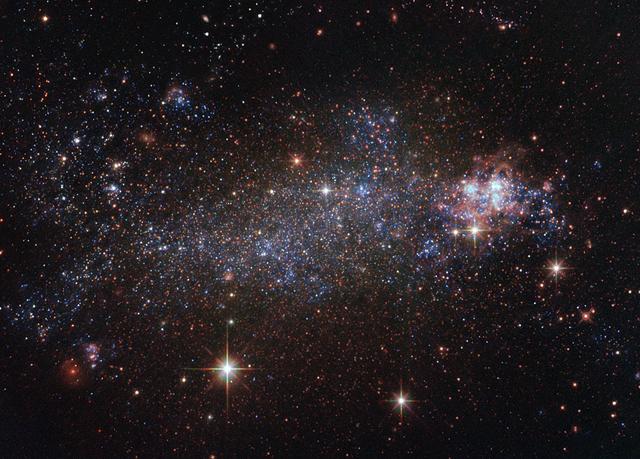
The Sun's glint reflects off the Gulf of Mexico and outlines the coasts of Texas and Louisiana. The International Space Station was orbiting 254 miles above Louisiana when an Expedition 58 crew member photographed the Gulf coast including Matagorda Bay, Galve…
Ver en NASA ↗🚀 Biblioteca espacial oficial
Imágenes y vídeos de NASA
Explora el catálogo multimedia público de NASA sin salir de TuPortalNews.
Explora temas destacados
Selecciona un tema o realiza una búsqueda personalizada.
6.531 resultados en NASA
This frame from an animation shows five versions of observations that NASA Curiosity made about one hour apart while Mercury was passing in front of the sun on June 3, 2014. Two sunspots, each about the diameter of Earth, also appear.
Ver en NASA ↗NASA Kepler mission has discovered a world where two suns set over the horizon instead of just one. The planet, called Kepler-16b, is the most Tatooine-like planet yet found in our galaxy and is depicted here in this artist concept.
Ver en NASA ↗These images, from 8 April 2003 show that depending upon the position of the Sun, the solar power stations in California Mohave Desert can reflect solar energy from their large, mirror-like surfaces directly toward one of NASA Terra cameras.
Ver en NASA ↗Sun-Earth Day WEBCAST - NASA TV; Host Paul Mortfield, Astronomer Stanford Solar Center and visiting students from San Francisco Bay Area Schools Documentation Technology Branch Video communications van (code-JIT) David Maurantonio, Paul Langston
Ver en NASA ↗Getting fuller! A BARREL balloon is filled with helium during the 2013-2014 mission campaign in Antarctica. Credit: NASA/Goddard/BARREL Read more: www.nasa.gov/content/goddard/nasas-barrel-returns-success... -- Three months, 20 balloons, and one very succ…
Ver en NASA ↗Getting ready to lay out a BARREL balloon to prepare for inflation. The helium stillages used to fill the balloon can be seen in the background. Credit: NASA/Goddard/BARREL/Brett Anderson Read more: www.nasa.gov/content/goddard/nasas-barrel-returns-succes…
Ver en NASA ↗BARREL researchers get ready to release the top part of the balloon, called the bubble, as it fills with enough helium to support itself. Only the top part of the balloon is inflated before launch since the helium expands as the balloon ascends. Credit: NAS…
Ver en NASA ↗A team member from South African research station, SANAE IV, helps unwrap the balloon from its protective yellow plastic cover just prior to inflation. Credit: NASA/Goddard/BARREL/Nicky Knox Read more: www.nasa.gov/content/goddard/nasas-barrel-returns-suc…
Ver en NASA ↗The BARREL team at the South African research station, SANAE IV, poses next to the instrument box, which will float in the atmosphere beneath the balloon that can be seen being inflated in the background. Credit: NASA/Goddard/BARREL/Brett Anderson Read mor…
Ver en NASA ↗BARREL team members lift up the instrument box below an inflated BARREL balloon to help with launch. Credit: NASA/Goddard/Francois Read more: www.nasa.gov/content/goddard/nasas-barrel-returns-success... -- Three months, 20 balloons, and one very successf…
Ver en NASA ↗Recovery of a BARREL balloon payload after its flight. The recovery was carried out by helicopter. This area is known to be heavily crevassed so the base mountaineer is seen here with a safety rope. Credit: NASA/Goddard/BARREL/Brett Anderson Read more: www…
Ver en NASA ↗Release of a BARREL balloon. The launch crew can be seen on the right holding the payload as the top of the balloon moves overhead where they can release it. Credit: NASA/Goddard/BARREL Read more: www.nasa.gov/content/goddard/nasas-barrel-returns-success..…
Ver en NASA ↗The BARREL team at the South African research station, SANAE IV, lay out the 130-foot-long balloon on the ground to prepare for inflation. The entire set up and launch process takes three to four hours. Credit: NASA/Goddard/BARREL/Nicky Knox Read more: www…
Ver en NASA ↗The BARREL instrument in Antarctica– prior to being encased in its protective box – destined to float beneath a giant balloon to study magnetic fields and energetic particles near the South Pole. Credit: NASA/Goddard/BARREL/Brett Anderson Read more: www.na…
Ver en NASA ↗A group picture of all the researchers – from various science projects -- at the South African research station, SANAE IV, Antarctica, in the (Southern) summer 2013-2014. Credit: NASA/Goddard/BARREL/Brett Anderson Read more: www.nasa.gov/content/nasas-barr…
Ver en NASA ↗A view looking over the payload – the instruments that fly under a balloon – while the BARREL balloon inflates. The orange parachute lies on the ground in front of the payload, while most of the balloon length can be seen stretched along the ground toward the…
Ver en NASA ↗The BARREL team at Halley Research Station in Antarctica, work to inflate a balloon. The long tube on the left is the inflation tube used to fill the top of the balloon with helium. Credit: NASA/Goddard/BARREL Read more: www.nasa.gov/content/goddard/nasas…
Ver en NASA ↗While large compared to a human, BARREL balloons are actually much smaller than typical science balloons, which can be as large as a football field. Credit: NASA/Goddard/BARREL/Brett Anderson Read more: www.nasa.gov/content/goddard/nasas-barrel-returns-su…
Ver en NASA ↗A BARREL balloon launches up into the sky, destined to float on the circumpolar winds around the South Pole for up to three weeks while measuring Earth's magnetic field and energetic particles from the radiation belts. Credit: NASA/Goddard/BARREL/Brett Ande…
Ver en NASA ↗Members of the BARREL team in Antarctica jump up and down in what they call the Low Wind Dance as they hope for the low wind conditions needed to launch another balloon. Credit: NASA/Goddard/BARREL/Brett Anderson Read more: www.nasa.gov/content/goddard/nasa…
Ver en NASA ↗The sun featured just one, rather small active region over the past few days, but it developed rapidly and sported a lot of magnetic activity in just one day (Apr. 11-12, 2018) as observed by NASA's Solar Dynamics Observatory.
Ver en NASA ↗An active region at the sun edge produced several M5-class medium sized flares over a ten-hour period on Apr. 3, 2017, as seen by NASA's Solar Dynamics Observatory.
Ver en NASA ↗When an active region rotated over to the edge of the sun, it presented NASA's Solar Dynamics Observatory with a nice profile view of its elongated loops stretching and swaying above it Mar. 8-9, 2017.
Ver en NASA ↗Contenido y metadatos proporcionados por la NASA Image and Video Library.