





/NASA’s%20Artemis%20III%20Announcement%20(Official%20NASA%20Trailer)~thumb.jpg)

A three-year-old chimpanzee, named Ham, in the biopack couch for the MR-2 suborbital test flight. On January 31, 1961, a Mercury-Redstone launch from Cape Canaveral carried the chimpanzee "Ham" over 640 kilometers down range in an arching trajectory that reac…
Ver en NASA ↗🚀 Biblioteca espacial oficial
Imágenes y vídeos de NASA
Explora el catálogo multimedia público de NASA sin salir de TuPortalNews.
Explora temas destacados
Selecciona un tema o realiza una búsqueda personalizada.
2.907 resultados en NASA
This picture, taken only minutes after NASA Mariner 10 made its closest approach to Mercury, is one of the highest resolution pictures obtained. Abundant craters in various stages of degradation dot the surface.
Ver en NASA ↗This image, from NASA Mariner 10 spacecraft which launched in 1974, is of the H-7 Beethoven Quadrangle, and lies in Mercury Equatorial Mercator. NASA Mariner 10 spacecraft imaged the region during its initial flyby of the planet.
Ver en NASA ↗Mercury True Color is in the Eye of the Beholder
Ver en NASA ↗This impact crater in the high northern latitudes of Mercury was recently named for the Bangladeshi painter Zainul Abedin 1914-1976. Abedin exhibits a complex crater structure with a smooth floor, wall terraces, and a central peak complex.
Ver en NASA ↗On January 9, 2008, NASA MESSENGER spacecraft snapped one of its first images of Mercury at a distance of about 2.7 million kilometers 1.7 million miles from the planet.
Ver en NASA ↗Shortly following NASA MESSENGER spacecraft closest approach to Mercury on January 14, 2008, the spacecraft Narrow Angle Camera NAC instrument acquired this image as part of a mosaic that covers much of the sunlit portion of the hemisphere.
Ver en NASA ↗Model of Mercury capsule used for wind tunnel testing.
Ver en NASA ↗Alan B. Shepard, Jr., America's first astronaut, stands in front of the Freedom 7 spacecraft shortly after completion of the third flight of the Mercury-Redstone (MR-3) vehicle, May 5, 1961. During the 15-minute suborbital flight, the Freedom 7 Mercury spacec…
Ver en NASA ↗Astronaut Alan B. Shepard, Jr. lifts off in the Freedom 7 Mercury spacecraft on May 5, 1961. This third flight of the Mercury-Redstone (MR-3) vehicle, developed by Dr. Wernher von Braun and the rocket team in Huntsille, Alabama, was the first marned space mis…
Ver en NASA ↗A close-up of the Mercury Laser Altimeter MLA profile of Mercury acquired during NASA MESSENGER spacecraft first Mercury flyby on January 14, 2008.
Ver en NASA ↗This computer generated mosaic from NASA Mariner 10 is of Mercury Tolstoj Quadrangle, named for the ancient Tolstoj crater located in the lower center of the image.
Ver en NASA ↗This image, from NASA Mariner 10 spacecraft which launched in 1974, is of the northern half of Mercury Shakespeare Quadrangle.
Ver en NASA ↗As NASA Mariner 10 approached Mercury at nearly seven miles per second on March 29, 1974, its TV camera took this picture from an altitude of 35,000 kilometers 21,700 miles The picture shows a heavily-cratered surface with many low hills
Ver en NASA ↗Astronaut John H. Glenn sits in a car in front of the east side of the Mercury Mission Control building. Glenn was the pilot for the Mercury-Atlas 6 mission aboard Friendship 7, which launched Feb. 20, 1962.
Ver en NASA ↗In this image, Mercury's horizon cuts a striking edge against the stark blackness of space. On the right, sunlight harshly brings the landscape into relief while on the left, the surface is shrouded in the darkness of night. This image was acquired as part o…
Ver en NASA ↗Astronaut Walter M. "Wally" Schirra, one of the original seven astronauts for Mercury Project selected by NASA on April 27, 1959. The MA-8 (Mercury-Atlas) mission with Sigma 7 spacecraft was the third marned orbital flight by the United States, and made the s…
Ver en NASA ↗S65-24623 (May 1962) --- Astronaut M. Scott Carpenter, prime pilot for the Mercury-Atlas 7 (MA-7) flight, is seen in Hangar S crew quarters during a suiting exercise. Carpenter is seated in a mock-up of his pilot's seat while fully suited. Photo credit: NASA
Ver en NASA ↗This image, from NASA Mariner 10 spacecraft which launched in 1974, is of the Michelangelo Quadrangle, which lies in Mercury southern polar region. The Mercurian surface is heavily marred by numerous impact craters.
Ver en NASA ↗The Kuiper Quadrangle was named in memory of Dr. Gerard Kuiper, an imaging team member, and well-known astronomer, of NASA Mariner 10 Venus/Mercury. The Kuiper crater is seen left of center in this image.
Ver en NASA ↗This image, from NASA Mariner 10 spacecraft which launched in 1974, is of the Borealis area H-1, located in Mercury northern hemisphere. The north pole is visible at the top of the image.
Ver en NASA ↗A three-year-old chimpanzee, named Ham, in the biopack couch for the MR-2 suborbital test flight. On January 31, 1961, a Mercury-Redstone launch from Cape Canaveral carried the chimpanzee "Ham" over 640 kilometers down range in an arching trajectory that reac…
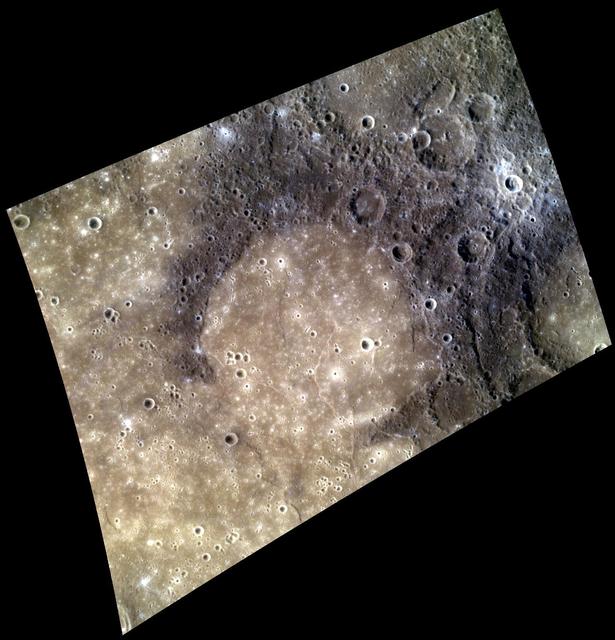
Ver en NASA ↗This NASA MESSENGER 3rd Mercury flyby image was quickly identified as a feature of high scientific interest, because of its fresh appearance, its distinctively colored interior plains, and extensional troughs on its floor.
Ver en NASA ↗The planet Mercury is seen in silhouette as it nearly completes transiting across the face of the Sun, Monday, Nov. 11, 2019, in Arlington, Virginia. Mercury’s last transit was in 2016. the next won't happen again until 2032. Photo Credit: (NASA/Bill Ingalls)
Ver en NASA ↗Contenido y metadatos proporcionados por la NASA Image and Video Library.