




/NASA’s%20Artemis%20III%20Announcement%20(Official%20NASA%20Trailer)~thumb.jpg)
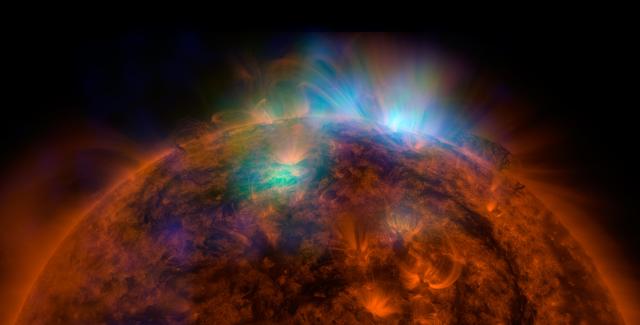
NASA's Solar Dynamics Observatory ran together three sequences of the sun taken in three different extreme ultraviolet wavelengths to show how different features appearing in one sequence are difficult to see in the others (Mar. 20-21, 2018).
Ver en NASA ↗🚀 Biblioteca espacial oficial
Imágenes y vídeos de NASA
Explora el catálogo multimedia público de NASA sin salir de TuPortalNews.
Explora temas destacados
Selecciona un tema o realiza una búsqueda personalizada.
6.531 resultados en NASA
This still image from an animation from NASA GSFC Solar Dynamics Observatory shows arches of magnetic field lines towered over the edge of the Sun as a pair of active regions began to rotate into view Apr. 5-6, 2016.
Ver en NASA ↗This still image from an animation from NASA GSFC Solar Dynamics Observatory shows dark strands of plasma hovering above the Sun surface beginning to interact with each other in a form of tug of war over two and a half days June 28-30, 2015.
Ver en NASA ↗The Yangtze River beams in the Sun's glint as wildfires burn in the surrounding forestland near the city of Wuhan in China's province of Hubei. The International Space Station was orbiting 262 miles above the Asian nation at the time of this photograph.
Ver en NASA ↗Sun-Earth Day WEBCAST - NASA TV; Host Paul Mortfield, Astronomer Stanford Solar Center and visiting students from San Francisco Bay Area Schools
Ver en NASA ↗Sun-Earth Day WEBCAST - NASA TV; Host Paul Mortfield, Astronomer Stanford Solar Center and visiting students from San Francisco Bay Area Schools
Ver en NASA ↗Sun-Earth Day WEBCAST - NASA TV; Host Paul Mortfield, Astronomer Stanford Solar Center and visiting students from San Francisco Bay Area Schools Paul Langston, Videographer operates camera
Ver en NASA ↗Sun-Earth Day WEBCAST - NASA TV; Host Paul Mortfield, Astronomer Stanford Solar Center and visiting students from San Francisco Bay Area Schools
Ver en NASA ↗Sun-Earth Day WEBCAST - NASA TV; Host Paul Mortfield, Astronomer Stanford Solar Center and visiting students from San Francisco Bay Area Schools
Ver en NASA ↗Sun-Earth Day WEBCAST - NASA TV; Host Paul Mortfield, Astronomer Stanford Solar Center and visiting students from San Francisco Bay Area Schools David Maurantonio, Videographer operates camera
Ver en NASA ↗Sun-Earth Day WEBCAST - NASA TV; Host Paul Mortfield, Astronomer Stanford Solar Center and visiting students from San Francisco Bay Area Schools
Ver en NASA ↗Sun-Earth Day WEBCAST - NASA TV; Host Paul Mortfield, Astronomer Stanford Solar Center and visiting students from San Francisco Bay Area Schools
Ver en NASA ↗NASA's Solar Dynamics Observatory observed no sunspots for almost two weeks (as of Feb. 1, 2018) and just has a single, tiny one that appeared on Jan. 31, 2018.
Ver en NASA ↗This combination of three wavelengths of light from NASA's Solar Dynamics Observatory shows one of the multiple jets that led to a series of slow coronal puffs on Jan. 17, 2013. The light has been colorized in red, green and blue. Read more: 1.usa.gov/UQi41p…
Ver en NASA ↗NASA's Solar Dynamics Observatory observed a substantial coronal hole rotated into a position where it is facing Earth on Aug. 9-11, 2017.
Ver en NASA ↗A small, but complex mass of plasma gyrated and spun about over the course of 40 hours above the surface of the Sun taken by NASA GSFC Solar Dynamics Observatory on Sept. 1-3, 2015.
Ver en NASA ↗At the edge of the sun, a large prominence and a small prominence began to shift, turn and fall apart in less than one day, observed by NASA's Solar Dynamics Observatory, May 8-9, 2017.
Ver en NASA ↗One active region at the edge of the Sun pushed out about ten thrusts of plasma in just over a day long period as observed by NASA's Solar Dynamics Observatory on July 9-10, 2016.
Ver en NASA ↗As an active region rotated into view, NASA's Solar Dynamics Observatory was able to observe well-defined magnetic loops gyrating above the sun between Mar, 23-24, 2017.
Ver en NASA ↗Caption: Glowing a dark magenta, the newly discovered exoplanet GJ 504b weighs in with about four times Jupiter's mass, making it the lowest-mass planet ever directly imaged around a star like the sun. Credit: NASA/Goddard/S. Wiessinger Using infrared data …
Ver en NASA ↗A substantial coronal mass ejection, or CME, blew out from side of the Sun, giving us a great view of the event in profile (June 17-18, 2015). NASA's Solar Dynamics Observatory caught the action in the 304 Angstrom wavelength of extreme ultraviolet light. The…
Ver en NASA ↗Coronal holes are areas of open magnetic fields from which solar wind rushes out into space. NASA's Solar Dynamics Observatory observed this long coronal hole that stretched out across more than half the diameter of the sun (Mar. 13-15, 2018).
Ver en NASA ↗Strands of plasma at the sun edge shifted and twisted back and forth over a 22-hour period, May 2-3, 2017. In this close-up from NASA's Solar Dynamics Observatory, the strands are being manipulated by strong magnetic forces associated with active region.
Ver en NASA ↗NASA's Solar Dynamics Observatory zoomed in to watch close-up the dynamics of this single active region on the sun over a two-day period on July 14-16, 2018. These regions are often the sources of large eruptions that cause solar storms.
Ver en NASA ↗Contenido y metadatos proporcionados por la NASA Image and Video Library.