





/NASA’s%20Artemis%20III%20Announcement%20(Official%20NASA%20Trailer)~thumb.jpg)

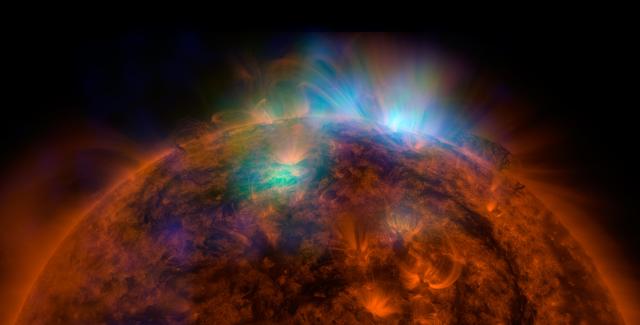
X-rays stream off the sun in this first picture of the sun, overlaid on a picture taken by NASA Solar Dynamics Observatory SDO, taken by NASA NuSTAR. The field of view covers the west limb of the sun.
Ver en NASA ↗🚀 Biblioteca espacial oficial
Imágenes y vídeos de NASA
Explora el catálogo multimedia público de NASA sin salir de TuPortalNews.
Explora temas destacados
Selecciona un tema o realiza una búsqueda personalizada.
6.530 resultados en NASA
This frame from an animation shows how the magnetic field lines emanating from our sun spiral out into the solar system as the sun rotates. NASA Voyager 1 is in an area scientists are calling the stagnation region, at the outer layer of the heliosphere.
Ver en NASA ↗The dark region seen on the face of the sun at the end of March 2013 is a coronal hole just above and to the right of the middle of the picture, which is a source of fast solar wind leaving the sun in this image from NASA Solar Dynamic Observatory.
Ver en NASA ↗This composite image of the Sun includes high-energy X-ray data from NASA's NuSTAR shown in blue; lower energy X-ray data from the XRT on the JAXA's Hinode mission shown in green; and ultraviolet light detected by the AIA on NASA's SDO shown in red.
Ver en NASA ↗This graphic shows the relative size of the Sun, upper left, compared to the two stars in the system known as Wolf-Rayet 140. The O-type star is roughly 30 times the mass of the Sun, while its companion is about 10 times the mass of the Sun.
Ver en NASA ↗Flaring, active regions of our sun are highlighted in this image combining observations from NASA's NuSTAR. During the observations, microflares went off, which are smaller versions of the larger flares that also erupt from the sun surface.
Ver en NASA ↗Facing the Sun
Ver en NASA ↗Filtering the Sun
Ver en NASA ↗NASA's Solar Dynamics Observatory sees the sun has been virtually spotless, as in no sunspots, a 11-day spotless stretch not seen since the last solar minimum many years ago.
Ver en NASA ↗Several times a day for a few days the Earth completely blocked the Sun for about an hour due to NASA's Solar Dynamics Observatory orbital path Feb. 15, 2017.
Ver en NASA ↗This panel illustrates the transit of the martian moon Phobos across the Sun. It is made up of images taken by NASA Mars Exploration Rover Opportunity.
Ver en NASA ↗This Solar Dynamics Observatory image of the Sun taken on February 1, 2013 in extreme ultraviolet light captures a heart-shaped dark coronal hole. Coronal holes are areas of the Sun's surface that are the source of open magnetic field lines that head way out …
Ver en NASA ↗Animation of a CME leaving the Sun, slamming into our magnetosphere. Credit: NASA/GSFC/SOHO/ESA Sound: Juan Carlos Garcia To learn more go to the SOHO website: sohowww.nascom.nasa.gov/home.html To learn more about NASA's Sun Earth Day go here: sunearthda…
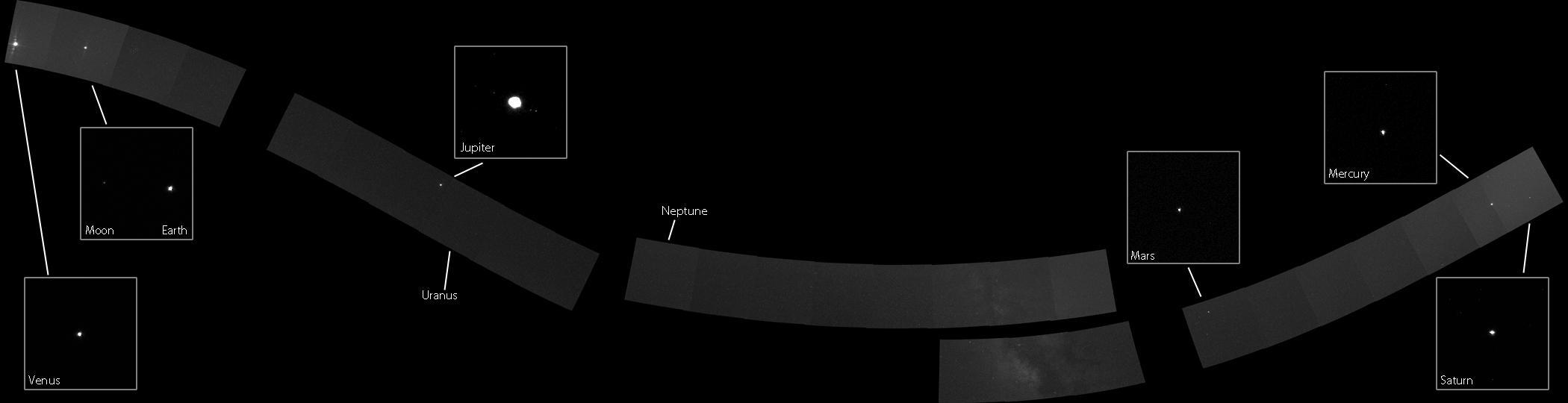
Ver en NASA ↗This color image of the sun, Earth and Venus was taken by the Voyager 1 spacecraft Feb. 14, 1990, when it was approximately 32 degrees above the plane of the ecliptic and at a slant-range distance of approximately 4 billion miles.
Ver en NASA ↗To view a video of the Gradient Sun go to: www.flickr.com/photos/gsfc/8103212817 Looking at a particularly beautiful image of the sun helps show how the lines between science and art can sometimes blur. But there is more to the connection between the two dis…
Ver en NASA ↗On Sept. 10, 2025, NASA's Solar Dynamics Observatory captured this image of the Sun.
Ver en NASA ↗Sun-Drenched Rhea
Ver en NASA ↗The Sun Also Rises
Ver en NASA ↗Herschel Sees the Sun
Ver en NASA ↗The Sun Sets on Rembrandt
Ver en NASA ↗Sun-bleached Rhea
Ver en NASA ↗Midnight Sun on Mars
Ver en NASA ↗Sun-striped Saturn
Ver en NASA ↗The Sun blew out a coronal mass ejection along with part of a solar filament over a three-hour period (Feb. 24, 2015). While some of the strands fell back into the Sun, a substantial part raced into space in a bright cloud of particles (as observed by the SOH…
Ver en NASA ↗Contenido y metadatos proporcionados por la NASA Image and Video Library.