





/NASA’s%20Artemis%20III%20Announcement%20(Official%20NASA%20Trailer)~thumb.jpg)

In Neptune outermost ring, 39,000 miles out, material mysteriously clumps into three arcs. Voyager 2 acquired this image as it encountered Neptune in August of 1989.
Ver en NASA ↗🚀 Biblioteca espacial oficial
Imágenes y vídeos de NASA
Explora el catálogo multimedia público de NASA sin salir de TuPortalNews.
Explora temas destacados
Selecciona un tema o realiza una búsqueda personalizada.
265 resultados en NASA
This contrast enhanced color picture of Neptune was acquired by NASA Voyager 2 on Aug. 14, 1989. As Voyager 2 approached Neptune, rapidly increasing image resolution is revealed striking new details. Bright, wispy clouds are seen overlying the Great Dar
Ver en NASA ↗This image of Neptune shows the discovery of shadows in Neptune atmosphere, shadows cast onto a deep cloud band by small elevated clouds. They are the first cloud shadows ever seen by NASA Voyager on any planet.
Ver en NASA ↗These two images of Neptune were taken by NASA Voyager 2 narrow angle camera when the spacecraft was about 12 million km 7.5 million miles from Neptune.
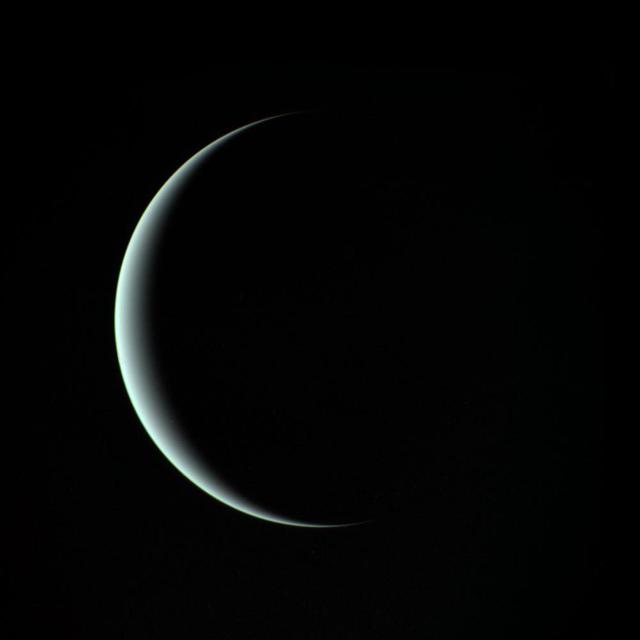
Ver en NASA ↗This dramatic view of the crescents of Neptune and Triton was acquired by Voyager 2 approximately 3 days, 6 and one-half hours after its closest approach to Neptune north is to the right.
Ver en NASA ↗This image of Neptune south polar region was obtained by NASA Voyager on Aug. 23, 1989. The image shows the discovery of shadows in Neptune atmosphere, shadows cast onto a deep cloud bank by small elevated clouds.
Ver en NASA ↗This photograph of Neptune shows three of the features that NASA Voyager 2 has been photographing during recent weeks. At the north is the Great Dark Spot, accompanied by bright, white clouds that undergo rapid changes in appearance.
Ver en NASA ↗These pictures of Neptune were obtained by NASA Voyager 2 on Apr. 26,1989. The picture on the right was taken five hours after that at left, during which time the planet rotated 100 degrees.
Ver en NASA ↗On July 23, 1989, NASA Voyager 2 spacecraft took this picture of Neptune through a clear filter on its narrow-angle camera. The image on the right has a latitude and longitude grid added for reference. Neptune Great Dark Spot is visible on the left.
Ver en NASA ↗This image of Neptune south polar region was obtained by NASA Voyager on Aug. 23, 1989. The smallest cloud features are 45 kilometers 28 miles in diameter. The image shows the discovery of shadows in Neptune atmosphere, shadows cast onto a deep cl
Ver en NASA ↗The bright cirrus-like clouds of Neptune change rapidly, often forming and dissipating over periods of several to tens of hours as seen in this sequence spanning two rotations of Neptune about 36 hours by NASA Voyager 2.
Ver en NASA ↗This image of Neptune was taken through the clear filter of the narrow-angle camera on July 16, 1989 by NASA Voyager 2 spacecraft. The image was processed by computer to show the newly resolved dark oval feature embedded in the middle of the dusky south
Ver en NASA ↗The bright cirrus-like clouds of Neptune change rapidly, often forming and dissipating over periods of several to tens of hours. In this sequence NASA Voyager 2 observed cloud evolution in the region around the Great Dark Spot GDS.
Ver en NASA ↗This photograph of Neptune was reconstructed from two images taken by NASA Voyager 2. At the north top is the Great Dark Spot, accompanied by bright, white clouds that undergo rapid changes in appearance.
Ver en NASA ↗This image was returned by NASA Voyager 2 spacecraft on July 3, 1989. The planet and its largest satellite, Triton, are captured in view; Triton appears in the lower right corner at about 5 oclock relative to Neptune.
Ver en NASA ↗These NASA Hubble Space Telescope views of the blue-green planet Neptune provide three snapshots of changing weather conditions. The images were taken in 1994 on 3 separate days when Neptune was 2.8 billion miles 4.5 billion kilometers from Earth.
Ver en NASA ↗These two NASA Hubble Space Telescope images provide views of weather on opposite hemispheres of Neptune. Taken Aug. 13, 1996; these composite images blend information from different wavelengths to bring out features of Neptune blustery weather.
Ver en NASA ↗This image captured by the NASA Voyager 2 spacecraft on July 30, 1989, was used to confirm the discovery of three new satellites orbiting Neptune.
Ver en NASA ↗The large, dark oval spot in Neptune atmosphere is just coming into view in this picture returned from NASA Voyager 2 spacecraft on June 30, 1989.
Ver en NASA ↗NASA New Horizons Long Range Reconnaissance Imager LORRI observed Neptune on June 23, apl2010, as part of a test of the critical optical navigation Annual Checkout ACO-4.
Ver en NASA ↗NASA Voyager 2 post-encounter view of Neptune south pole as the spacecraft sped away on a southward trajectory.
Ver en NASA ↗These three images of Neptune were acquired 90 minutes apart by NASA Voyager 2 spacecraft on April 3, 1989, from a range of 208 million kilometers 129 million miles. Several atmospheric features clouds are visible.
Ver en NASA ↗This photograph of Neptune southern hemisphere was taken by the narrow-angle camera on NASA Voyager 2 when the spacecraft was 4.2 million km 2.6 million miles from the planet.
Ver en NASA ↗During August 16 and 17, 1989, the Voyager 2 narrow-angle camera was used to photograph Neptune almost continuously, recording approximately two and one-half rotations of the planet.
Ver en NASA ↗Contenido y metadatos proporcionados por la NASA Image and Video Library.